

B2B ecommerce has evolved from an experimental side project into critical infrastructure for manufacturing companies, with the U.S. International Trade Administration forecasting that the global B2B ecommerce market will reach $36 trillion by 2026. Manufacturing ecommerce now accounts for a significant portion of total manufacturing sales volume, handling complex pricing, configured equipment, spare parts reordering, and bulk ordering for distributors, dealers, and large end customers. It enables features like customer-specific pricing tied to negotiated contracts, accurate product availability from multiple plants, and 24/7 self-service ordering—allowing maintenance technicians to reorder parts at any time without assistance.
Despite these advances, many manufacturers still face challenges such as manual order entry, spreadsheet-based pricing, slow quote turnaround, disconnected ERP and CRM systems, and limited supply chain visibility. With a majority of B2B buyers now expecting digital-first experiences, the gap between buyer demands and manufacturer capabilities has become a significant revenue issue. This guide offers practical insights for manufacturers, especially industrial and equipment OEMs, on planning, building, and scaling B2B ecommerce for real revenue growth and operational efficiency, including choosing the right platform, integrating ecommerce with ERP and supply chain systems, designing customer portals, and aligning ecommerce strategy with sales and marketing.
Table of Contents
From Paper POs to Portals: Past, Present, and Future of B2B Ecommerce for Manufacturers
What Is B2B Ecommerce for Manufacturers (and How It Differs from Distributors)
Why Manufacturers Invest in B2B Ecommerce: Revenue, Resilience, and Customer Satisfaction
Core Benefits of Manufacturing Ecommerce for Industrial and Equipment Brands
Key Features Manufacturers Need in a B2B Ecommerce Platform
Integrating Ecommerce with ERP, CRM, and the Supply Chain
Designing High-Performing Customer Portals for Manufacturers
Building a B2B Ecommerce Roadmap: From Pilot Storefront to Enterprise Backbone
Common Pitfalls Manufacturers Face When Integrating Ecommerce
How Ecommerce Changes the Role of the Manufacturing Sales Team
Measuring ROI: Costs, Value, and Time-to-Impact for Manufacturing Ecommerce
Why Choose a Specialized Industrial-Focused Ecommerce Partner
Take the Next Step: Turn B2B Ecommerce into a Growth Engine, Not Just an Online Catalog
Frequently Asked Questions About B2B Ecommerce for Manufacturers
From Paper POs to Portals: Past, Present, and Future of B2B Ecommerce for Manufacturers
The journey from paper purchase orders to modern digital sales channels breaks into three distinct eras.
Past (up to ~2015). Ordering happened by phone, fax, and email. Catalogs were printed PDFs. Inside sales teams manually re-keyed every order into ERP. Pricing lived in spreadsheets and tribal knowledge. Customer portals did not exist. Trade shows and field visits were the primary demand generation tools.
Present (2024–2026). B2B ecommerce now accounts for a significant share of manufacturing activity. According to the U.S. Census Bureau, ecommerce represented approximately 66.6% of total U.S. manufacturing shipment value in 2024. Manufacturing companies are deploying ERP-integrated storefronts with basic self-service, bulk reordering, and quote-to-order workflows. Zeus Group, for example, migrated from manual email orders to a self-service portal supporting over 12,000 SKUs across 17 countries. The result was a 62% reduction in manual order processing within the first quarter after launch. Baart Industrial Group deployed roughly 25,400 SKUs in a platform integrated with Infor ERP and exceeded revenue expectations without adding sales headcount.
Future (2027 and beyond). Expect AI-driven search and configuration, predictive reorder suggestions, omni-channel orchestration across dealers and marketplaces, product-level sustainability data, and automated exception handling in the supply chain. Over 80% of B2B practitioners are investing in AI for ecommerce, with agentic AI (bots that handle quoting, reorder workflows, and procurement suggestions) moving from pilot to production.
Think of an industrial pump manufacturer that used to take phone calls for replacement seals. Now, maintenance teams log in to a 24/7 portal, search by equipment model, and reorder kits in minutes with contract pricing applied automatically.
What Is B2B Ecommerce for Manufacturers (and How It Differs from Distributors)
B2B ecommerce for manufacturers is the use of digital sales channels, including web stores, customer portals, dealer portals, and marketplaces, to sell directly to business customers while reflecting complex pricing, product configurations, and production realities. Manufacturers face unique challenges selling complex products online that distributors and retailers simply do not encounter.
Here is how manufacturer ecommerce requirements differ from a typical distributor setup:
- Manufacturers must support configurable or engineered-to-order equipment, with Bill of Materials dependencies and component compatibility rules. Distributors typically sell fixed part numbers off the shelf.
- Manufacturers deal with variable lead times tied to production schedules and plant capacity. Distributors usually ship from stocked inventory with more predictable delivery.
- Pricing for manufacturers involves negotiated contracts, customer specific pricing, territorial restrictions, and volume breaks that change by account. Distributors more commonly apply published wholesale margins.
- Manufacturers often sell to dealers, OEM integrators, and service firms through multiple sales models simultaneously. Distributors tend to serve installers, contractors, and end users in a flatter structure.

B2B platforms must support unique commercial workflows like purchase orders and RFQs. Ecommerce platforms must support complex pricing and multiple sales models in a single environment. Generic “B2B-ready” ecommerce solutions are rarely enough when you need contract pricing, territory rules, multi-plant inventory management, return-to-warehouse logic, and dealer programs all working together.
Manufacturing ecommerce often supports multiple models at once: dealer and distributor sales, key accounts with account specific catalogs, MRO spares, and sometimes direct to consumer channels for standard components or aftermarket parts.
Why Manufacturers Invest in B2B Ecommerce: Revenue, Resilience, and Customer Satisfaction
Since 2020, macro forces have made the case undeniable. Pandemic disruptions and supply chain shocks exposed how fragile a business model built on face-to-face marketing and trade show pipelines can be. Manufacturers can increase sales by reducing reliance on face-to-face marketing and shifting to digital channels. Roughly 75% of B2B buyers now prefer self-service digital transactions, and that number continues to climb.
An effective B2B marketing strategy for equipment manufacturers can complement ecommerce investments by attracting qualified buyers, supporting digital sales channels, and reducing reliance on traditional sales methods.
Revenue growth. Digitizing the online ordering experience often moves ecommerce from single-digit revenue contribution to 30–60% of total order volume over several years. B2B ecommerce enables faster purchase cycles by providing buyers 24/7 access to pricing, configuration, and ordering. Advanced ecommerce platforms support targeted product recommendations that increase average order values through add-on suggestions and cross-sell.
Operational efficiency. Ecommerce allows manufacturers to automate order processing and inventory management, cutting quote turnaround times and eliminating duplicate data entry. One industrial parts manufacturer using an enterprise-grade b2b ecommerce platform reduced order processing time from 48 hours to 14 hours while handling more volume without scaling headcount. C.E. Smith integrated their ecommerce and EDI channels into ERP, eliminating manual entry and avoiding the need to hire four to six new staff, with ROI achieved in approximately six months.
Risk reduction and resilience. A robust ecommerce channel acts as a buffer during supply chain disruptions. Customers can see lead times, check real-time product information, find substitute products, and track order status without calling anyone. This transparency reduces overselling and cancellation risk.
Customer satisfaction and retention. Modern buyers measure manufacturers against consumer shopping experiences. They expect 24/7 access to pricing, availability, documentation, shipment tracking, and order history through customer portals. Effective implementation of b2b ecommerce leads to improved customer retention and experience. Ecommerce allows manufacturers to bypass traditional distributors when it makes sense, and direct-to-consumer sales can preserve higher profit margins.
Core Benefits of Manufacturing Ecommerce for Industrial and Equipment Brands
Here are six core benefits that make b2b ecommerce a competitive advantage for manufacturing companies:
Improved reach. B2B ecommerce expands manufacturers’ reach to global markets. An online store allows you to serve small or remote accounts, long-tail buyers, and prospective customers in new markets without adding field reps. Manufacturers can reach global markets through an online presence that works around the clock.

Complex pricing made manageable. A b2b ecommerce platform can surface negotiated pricing, volume breaks, custom pricing, and customer specific pricing accurately online, reducing disputes and AR issues. Complex pricing structures are supported by customer-specific catalogs that show each account exactly what they should see. B2B ecommerce platforms enable tiered pricing and volume discounts for repeat customers automatically.
Scalability without headcount. Manufacturers can handle higher order volumes without increasing costs by automating routine transactions and using self-service tools. Ecommerce platforms can provide quick reorder options for buyers, freeing your sales team to focus on complex deals rather than re-keying orders.
Better data and forecasting. B2B ecommerce enhances customer insights through data analytics. Customer data from search terms, abandoned carts, configuration patterns, and customer behavior informs demand generation, inventory forecasting, and product roadmap decisions. Data-driven insights from b2b ecommerce help in inventory forecasting and marketing decisions.
Supply chain visibility. Real-time inventory visibility optimizes stock levels and reduces costs. When accurate product availability, lead times, and shipment tracking are visible through the portal, both customers and internal teams plan better. Automated shipping notifications enhance customer experience and efficiency.
Brand control and D2C/D2B opportunities. Manufacturers can test direct access to end customers without dismantling their dealer networks. Segmented pricing, private customer groups, and account specific catalogs let you manage both direct and partnership digital sales channels while maintaining brand consistency. Personalization drives engagement and loyalty in b2b ecommerce, and personalized pricing can enhance customer experiences significantly.
Key Features Manufacturers Need in a B2B Ecommerce Platform
Many ecommerce platforms were designed for wholesalers or light B2B, not industrial manufacturers with ERP-driven processes. Most ecommerce platforms lack native support for the workflows manufacturers rely on daily. Modern ecommerce technology adapts to B2B companies’ needs, but only if you choose the right platform from the start.
Complex pricing support. You need native handling of contract tiers, volume discounts, regional pricing, temporary promotions, and guardrails for sales representative overrides, all drawn from ERP or a pricing engine as the system of record. Real-time product information is expected by B2B customers, and your platform must deliver it without manual intervention.
Configurable products and light CPQ. Manufacturers often require platforms that can manage complex product configurations. If you sell complex products like conveyors, packaging lines, or process skids, buyers need guided configuration with valid options, compatibility rules, and dynamic pricing. Digital quoting features in b2b ecommerce streamline the sales process for both buyer and seller.
Robust catalog and documentation. Ecommerce platforms can bulk-edit product catalogs efficiently, but the platform must also handle downloadable drawings, manuals, safety data sheets, and tens of thousands of SKUs, kits, and variants. Strong PIM integration keeps product content consistent across ecommerce sites and other sales channels.
Customer portals for repeat buyers. Self-service features allow customers to manage ordering independently 24/7. Core capabilities include saved lists, contract catalogs, one-click reorder from order history, open order visibility, shipment tracking, and invoice access. Ecommerce platforms can provide quick reorder options for buyers that reduce cycle times dramatically.
Security, permissions, and approvals. Role-based access (plant engineer vs purchasing manager), multi-user company accounts, and built-in approval workflows are essential for business customers. B2B platforms must support unique commercial workflows including purchase order approval chains and spending limits by role.
Integrating Ecommerce with ERP, CRM, and the Supply Chain
Integrating ecommerce is not just syncing orders. It is about creating one operational backbone so data flows cleanly across ERP, CRM, warehouse systems, logistics systems, and finance. Ecommerce platforms should integrate with ERP and CRM systems as a baseline requirement, not a phase-two nice-to-have.
ERP as source of truth. Pricing, inventory, credit terms, tax rules, and order history must originate from ERP (whether SAP, Microsoft Dynamics, Infor, Epicor, or others) to avoid inconsistencies and shadow databases. Integration supports real-time data sharing across departments, ensuring that every customer sees the correct negotiated contracts and availability.
Bidirectional data flows. True ERP integration means real-time inventory updates flow to ecommerce, online orders write directly back to ERP with correct item and warehouse codes, and status updates feed customer portals automatically. Seamless integration enhances automated fulfillment processes and keeps the buying process smooth from click to delivery.
CRM and sales alignment. Ecommerce data including quotes, abandoned carts, and self-service activity should flow into CRM systems so sales reps see where accounts are stuck. This visibility lets reps intervene proactively on complex buying journeys rather than waiting for a phone call. Customer relationships benefit when the sales team has full context on what existing customers are doing in the portal.

Supply chain integration. Connecting ecommerce to production planning and logistics (carrier APIs, 3PLs, freight rating) improves lead time accuracy, shipping cost estimations, and on-time delivery. When your supply chain is visible through the portal, customers can make data driven decisions about alternatives and timing.
Implementation pattern. Strong integration reduces errors and improves data security. Use APIs and middleware selectively, but avoid over-customization that makes upgrades impossible. Prioritize clean data and well-defined existing sales processes before wiring everything together. Many manufacturers struggle with integrating ecommerce into existing systems because they skip this step.
Designing High-Performing Customer Portals for Manufacturers
Modern buyers expect powerful customer portals, not just public catalogs. They want a single login where they can manage the full relationship with the manufacturer. Robust self-service portals improve customer satisfaction and streamline reordering across every account.
Must-have capabilities. Core features include viewing contract-specific catalogs with negotiated pricing, complete order history, reorder templates, shipment status, invoice access, and document libraries tailored to that account. Account management tools should let multiple users within a company operate with appropriate permissions.
Self-service workflows. Buyers should be able to request quotes on configured equipment, submit RFQs for custom projects, manage RMA requests, and download certificates or compliance documentation without calling support. Self-service portals help reduce routine customer service requests, freeing your team to focus on high-value interactions. This is how you engage customers without adding headcount.
UX considerations. Clean navigation, fast search across large parts catalogs, and mobile-friendly interfaces for technicians in the field are non-negotiable. Applying the principles of high-converting website design can help manufacturers create customer portals that simplify navigation, improve engagement, and encourage online orders. Simple registration and onboarding flows reduce friction for new business customers. The online ordering experience should meet customer expectations shaped by modern consumer shopping interfaces.
Business impact. Strong portal capabilities reduce inbound support volume, drive higher customer satisfaction, accelerate reorder cycles, and create stickier customer relationships that are harder for competitors to disrupt. Customer loyalty increases when buyers build templates, saved lists, and workflows inside your portal. Effective implementation leads to measurable improvements in customer retention.
Building a B2B Ecommerce Roadmap: From Pilot Storefront to Enterprise Backbone
Treat ecommerce as a phased program, not a one-off IT project. The manufacturers who succeed plan clear milestones across 6-month, 18-month, and 3-year horizons. This approach lets you prove value quickly while building toward scalable growth.
Phase 1 – Foundation (6–12 months). Start with one region or product line. Integrate basic ERP data (pricing, inventory, customer accounts). Launch a limited-scope portal focused on core repeat orders and spare parts. Clean up product data, price books, and SKU structures. This is where implementing ecommerce begins.
Phase 2 – Expansion (12–24 months). Add more product lines, customer segments (dealers, OEM partners, key accounts), enhanced self-service features, more robust analytics, and better content including video, guides, and calculators. Extend to multiple storefronts or regions. Build out the ecommerce website to serve customers across new markets.
Phase 3 – Optimization (24+ months). Introduce AI-powered search, predictive reorder prompts, more granular personalization, and advanced supply chain integrations such as automatic alternative suggestions when SKUs are constrained. This is where your ecommerce strategy matures into a true enterprise backbone.
Governance and ownership. Cross-functional ownership across sales, marketing, IT, and operations is essential. Regular steering meetings keep the ecommerce program aligned with your broader manufacturing business strategy. Define who owns product data, pricing, inventory accuracy, and customer hierarchy, and hold them accountable.
Common Pitfalls Manufacturers Face When Integrating Ecommerce
Use this as a risk checklist before and during implementation:
- Underestimating data cleanliness. Launching with outdated pricing, incomplete specs, or mismatched SKUs between ERP and ecommerce erodes trust and causes order errors. Ecommerce automates order processing and inventory management, but only if the underlying data is accurate.
- Choosing generic platforms for complex pricing. Selecting a low-cost, B2C-focused ecommerce platform leads to years of custom workarounds for complex pricing, approvals, and bulk ordering features. Total cost of ownership often far exceeds what a purpose-built b2b ecommerce platform would have cost.
- Ignoring change management. Failing to train sales reps, customer service, and dealers results in low adoption and continued reliance on manual processes. Internal teams need hands-on training with the portal, not just a link to documentation.
- Over-customizing too early. Building dozens of bespoke features before the basics work reliably delays launch and inflates cost. Launch with a solid core, then iterate based on real usage and customer behavior.
- Lack of clear success metrics. Not defining KPIs before go-live (ecommerce revenue share, order cycle time, error rate, customer satisfaction scores) makes it hard to prove ROI and secure budget for Phase 2.
How Ecommerce Changes the Role of the Manufacturing Sales Team
A common fear is that b2b ecommerce will replace sales reps. The reality is different. Leading manufacturers use digital tools to make reps more effective, not redundant. When routine orders move to self-service, the sales team shifts from order takers to advisors.
Modernizing the B2B sales funnel helps manufacturers align digital ordering channels with sales teams, allowing representatives to focus on more complex opportunities and customer relationships.
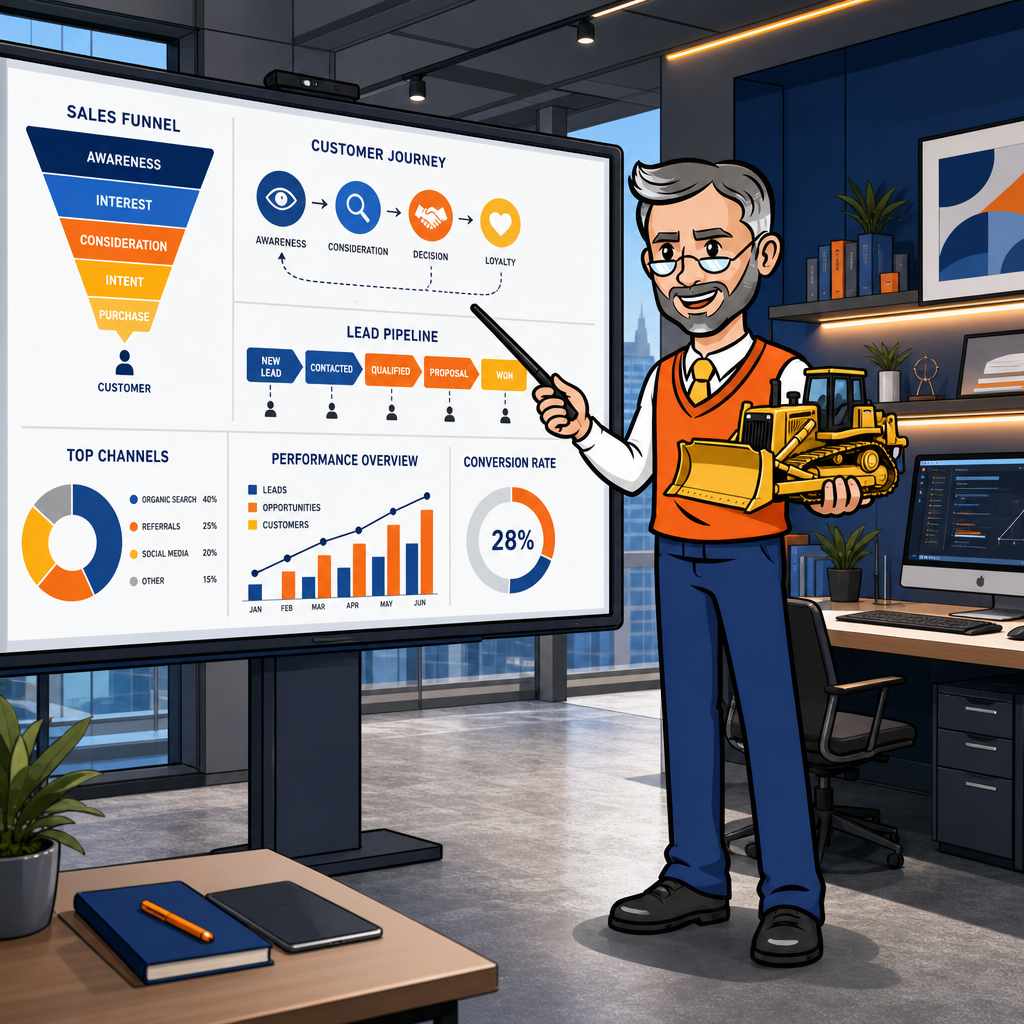
From order takers to advisors. Reps stop manually entering routine POs and start focusing on complex deals, multi-plant contracts, and consultative work. A sales representative helping a customer optimize a material handling system creates far more value than one re-keying a spare parts order.
Sales working inside the portal. The best b2b ecommerce platforms give sales reps a native console where they can see customer activity, build quotes, create carts on behalf of customers, and guide buyers through complicated configurations. This is how you streamline sales processes while keeping the human touch.
Aligning incentives. Revisit compensation and territory models so reps are rewarded for revenue that flows through online sales and customer portals. If ecommerce-driven revenue does not count toward quota, expect resistance. Align incentives to prevent channel conflict.
Training and adoption. Practical training for sales and customer service teams is essential. Use role-based workflows and example scenarios, like assisting a buyer stuck on a configuration or helping a dealer navigate account specific catalogs. Change management is as important as the technology itself.
Measuring ROI: Costs, Value, and Time-to-Impact for Manufacturing Ecommerce
Measuring marketing ROI in manufacturing ecommerce is multidimensional: increased revenue, cost savings, fewer errors, faster cash collection, and higher customer lifetime value.
Cost components. Expect costs across platform licensing, implementation and integration with ERP and CRM, data cleanup, internal training, and ongoing optimization. For a mid-market manufacturer, initial implementation typically ranges from the low six figures to mid six figures depending on complexity. Automation in b2b ecommerce reduces manual data entry, enhancing operational efficiency across the board.
Value components. Quantifiable gains include reduced order processing time per order, incremental revenue from new markets or long-tail accounts, higher average order values from cross-sell and upsell, and reduced DSO through more accurate invoicing. B2B ecommerce platforms streamline wholesale operations for manufacturers and free up resources. Manufacturers can handle higher order volumes without increasing costs once the system is running.
Time-to-value. First operational efficiencies (fewer errors, faster processing) typically appear within 3–6 months of go-live. More substantial revenue shifts (share of orders through portal, growth in new markets, cross-sell impact) generally become clear within 12–24 months. Full ecosystem maturity with AI and advanced orchestration may take 24–36 months.
Simple ROI framework. If your ecommerce channel saves the equivalent of two full-time clerks ($200,000 burdened annually), generates $500,000 in incremental revenue from long-tail accounts at 20% margin, and reduces order errors by 50%, payback on implementation often arrives within 12 months. Factor in higher average order value from recommendations, and the math gets even stronger.
Why Choose a Specialized Industrial-Focused Ecommerce Partner
Manufacturers get better outcomes when they work with partners who understand industrial buying cycles, dealer networks, and long, technical sales processes. A generalist agency that builds consumer ecommerce sites is unlikely to understand BOMs, production constraints, or the nuances of selling configured equipment through a dealer channel.
Deep manufacturing expertise. Look for experience with heavy equipment, material handling, food processing equipment, warehouse automation, construction equipment, and other industrial segments. This is not the same as building another online store for apparel or consumer goods.
Revenue-first strategy. The right partner ties ecommerce to demand generation, SEO, AI-powered search visibility, CRM usage, and conversion optimization, connecting web activity directly to pipeline and revenue. Ecommerce is a revenue channel, not just a technology project.
Full-funnel capabilities. Beyond platform builds, you need content development, product-page SEO, paid campaigns to drive prospective customers into the portal, and ongoing testing to improve conversion rates. A comprehensive approach to digital marketing for equipment manufacturers helps connect ecommerce platforms with SEO, paid campaigns, and lead generation strategies that support revenue growth. The goal is to serve customers across every stage of the buying process.
Long-term partnership. Continuous optimization, analytics, and roadmap planning keep the ecommerce channel aligned with new products, new territories, and evolving customer expectations through 2027 and beyond. Your ecommerce solutions should never sit still.
Take the Next Step: Turn B2B Ecommerce into a Growth Engine, Not Just an Online Catalog
B2B ecommerce for manufacturers is now a core driver of revenue growth, customer satisfaction, and operational efficiency. It is not an experimental side project. The manufacturers winning in 2027 have built their ecommerce strategy around the right platform for complex pricing, tight ERP integration with the supply chain, well-designed customer portals, and strong alignment between their sales team and marketing engine.
Start by auditing your current ordering process. Map where your business customers experience friction, where manual processes slow you down, and where you are losing deals to competitors with better digital sales channels. Then take a concrete next step: schedule a strategy conversation with a manufacturing-focused ecommerce and revenue partner who understands your manufacturing industry, your dealer networks, and the complexities of selling configured equipment online.
The best approach is to start with a focused pilot that proves value quickly, then scale the program into a true digital backbone for your manufacturing business. The competitive advantage belongs to manufacturers who act now rather than wait for perfection.
Frequently Asked Questions About B2B Ecommerce for Manufacturers
How is B2B ecommerce different for manufacturers compared to distributors or retailers?
Manufacturers typically deal with engineered or configured products, multi-level Bills of Materials, production lead times, and plant capacity constraints that must be reflected in the ecommerce experience. Distributors often have simpler catalogs with static pricing and stocked inventory. A manufacturer selling both standard components and custom assemblies needs the platform to handle quick orders alongside guided configuration and quote workflows. The difference is not cosmetic; it is structural and requires purpose-built ecommerce solutions.
Can manufacturers use popular platforms like Shopify or WooCommerce for complex B2B ecommerce?
These platforms can handle basic B2B use cases with fixed pricing and simple catalogs. However, they often require extensive customization, plugins, or middleware to manage complex pricing, approval workflows, and ERP-driven logic. Zeus Group, for example, migrated from WooCommerce to a more robust platform after outgrowing its capabilities. Manufacturers with configurable equipment, tiered negotiated contracts, or multi-warehouse fulfillment should evaluate platforms designed specifically for industrial B2B complexity. Prioritize integration, complex pricing, and long-term maintainability over initial license cost alone when selecting the right platform.
How important is ERP integration for manufacturing ecommerce success?
ERP integration is essential, not optional. When prices, inventory, tax rules, and credit status are governed in ERP, operating without integration means mismatched data, order errors, and painful manual reconciliation. A healthy integration means ecommerce reads customer specific pricing and inventory from ERP, writes orders back with correct item and warehouse codes, and updates status for portal visibility. A phased approach is viable: start with nightly syncs, then move toward near real-time APIs as your ecommerce program matures.
Will launching B2B ecommerce hurt my dealer or distributor relationships?
Managed well, ecommerce strengthens dealer networks by giving them better digital tools: dealer-only pricing, co-branded portals, shared catalogs, and easier access to availability and documentation. Use segmentation (end-user vs dealer ecommerce sites), territory protections, and shared customer data that dealers can use for smarter stocking decisions. Clear communication with channel partners about how ecommerce supports, not replaces, their role is critical to maintaining strong customer relationships.
How long does it take a typical manufacturer to launch a meaningful ecommerce channel?
A focused pilot portal leveraging existing ERP and product data can often go live in 3–6 months. A fully mature, multi-region ecosystem typically evolves over 18–36 months. Key milestones include discovery and requirements, data cleanup, platform configuration and integration, pilot launch, then iterative enhancements based on real usage. The biggest schedule risks usually come from data quality issues and internal decision delays, not the technology itself.
What signs indicate it’s time for our manufacturing business to invest seriously in ecommerce?
Practical triggers include rising order errors from manual entry, existing customers asking for online ordering or portals, inside sales teams overwhelmed with routine reorders, and competitors offering advanced portals that attract your prospective customers. Frequent pricing disputes, long quote cycles, and lack of visibility into order status are also strong indicators. These are leading indicators that customer expectations have already shifted, even if your revenue is still heavily offline today. Manufacturers invest in ecommerce when the cost of inaction exceeds the cost of building.