

This is a hands-on guide for email marketing in the manufacturing industry, written for the realities of 2027. Whether you run a heavy equipment OEM, a specialty parts shop, or an equipment dealer network, this playbook covers what actually works right now-strategy, platforms, automation, measurement, and the mistakes that quietly kill campaigns.
It is written for owners, sales leaders, and marketing teams at manufacturers, OEMs, and equipment dealers who want to connect email marketing efforts directly to pipeline and revenue.
Table of Contents
- Why Email Marketing Still Wins for Manufacturers in 2027
- Start With Outcomes: Defining an Email Marketing Strategy for Your Plant or OEM
- Building a High-Quality Email List Without Buying Contacts
- Segmentation: Turning One Big List Into Focused Manufacturing Audiences
- Choosing the Right Email Marketing Platform for a Manufacturing Business
- Creating Email Content That Engineers and Buyers Actually Read
- Design, UX, and Technical Setup for High-Deliverability Emails
- Email Automation Flows That Support the Manufacturing Sales Cycle
- Measurement, KPIs, and Continuous Optimization
- Common Email Marketing Mistakes Manufacturers Should Avoid
- Why Choose a Specialist Partner for Manufacturing Email Marketing
- Next Steps: Putting Your Email Marketing Strategy Into Action
- FAQs About Email Marketing for Manufacturers
Why Email Marketing Still Wins for Manufacturers in 2027
Despite AI search, shifting social media accounts, and new digital marketing channels appearing every year, email marketing delivers an average ROI of $42 for every $1 spent in the manufacturing sector. That figure consistently outperforms trade shows, print catalogs, and cold calling-channels that eat up travel budgets, printing costs, and hours of sales team time with far less measurable return.
Consider the numbers: manufacturing email campaigns regularly see open rates between 23% and 37%, with click through rate benchmarks landing in the 2.8% to 4.2% range. Conversion rates to actions like RFQ submissions hover around 2.4%. And 99% of email users check their email daily, giving you a direct line to engineers, procurement managers, and plant managers without paying for ad impressions or fighting algorithm changes.
Email marketing allows manufacturers to build relationships and generate leads with targeted content across long sales cycles. It supports dealer networks, repeat orders for consumables and spare parts, and relationship-based selling that equipment companies depend on. Additionally, it also helps improve customer retention and loyalty-critical when lifetime value per account can reach six or seven figures. Unlike renting attention on marketplaces or social platforms, you own your email list. No algorithm shift can take that away.
The rest of this article walks through an email marketing strategy built specifically for manufacturers, from setting goals to choosing platforms, automation, measurement, and beyond.
Start With Outcomes: Defining an Email Marketing Strategy for Your Plant or OEM
Most email marketing fails in manufacturing because there is no clear objective behind the sends. Campaigns go out sporadically, every message is a thinly veiled sales pitch, and no one connects the effort to a measurable business outcome. Without goals, you cannot tell whether email is working or wasting your marketing team’s time.
Manufacturing purchases often involve multiple decision-makers and long evaluation periods. Your email marketing strategy needs to account for that complexity by tying each campaign to a specific, measurable objective and a defined target audience.

Examples:
- Increase RFQ submissions from distributors by 15% this quarter
- Drive more CAD file or product spec downloads from design engineers
- Boost demo or factory tour requests from prospective customers
- Improve distributor portal logins and order placements
- Increase service contract renewals or spare-parts revenue from current customers
Each objective should connect to a clear call to action and a specific audience segment. A maintenance supervisor needs a different CTA (“Schedule preventive service”) than a design engineer (“Download the 3D model”). Map your email campaigns to the B2B sales funnel: awareness content like industry insights and compliance updates, consideration content like application notes and comparisons, decision content like ROI calculators and customer success stories, and post-sale content like training invitations and service reminders.
Align your cadence with real-world events. Plan sends around trade shows, Q4 capex planning windows, product launch dates, and seasonal maintenance windows. This keeps your brand top of mind when budgets are being allocated and decisions are being made.
Building a High-Quality Email List Without Buying Contacts
Building a quality email list is essential for effective marketing and supports broader manufacturing lead generation efforts. Purchased or rented lists almost always backfire for a manufacturing company: low engagement, high bounce rates, spam complaints, and damaged sender reputation that hurts deliverability for every future campaign you send. Manufacturing buyers are skeptical by nature-irrelevant emails from unknown senders go straight to trash.
Grow your list from owned channels instead:
- RFQ and quote request forms on your website
- Service and support request forms
- Trade show marketing and badge scans with explicit opt-in
- Webinar and workshop registrations
- Distributor portals where dealers log in for resources
- Downloadable lead magnets tied to real workflows
Effective lead magnets for 2027 include a yearly industry benchmarking report (e.g., “2027 Machinery Downtime Benchmarks”), a pre-shutdown safety inspection checklist, CAD or 3D model libraries, and ROI or total-cost-of-ownership calculators. These are valuable resources that attract the right people.
Compliance with regulations like CAN-SPAM, CASL, and GDPR is crucial for email marketing in manufacturing. The Federal Trade Commission’s CAN-SPAM compliance guide explains the requirements for commercial emails, including accurate sender information, unsubscribe mechanisms, and honoring opt-out requests within 10 business days. Use clear opt-in language, offer easy unsubscribes, and honor removal requests promptly. Opt-in features enhance engagement rates and ensure authenticity across your list.
As soon as someone joins, fire a simple welcome sequence: a thank-you email introducing your brand, a follow-up sharing a useful resource, a case study, and an invitation to deeper engagement. Each email should carry one clear call to action-nothing more.
Segmentation: Turning One Big List Into Focused Manufacturing Audiences
Sending the same email to your entire audience is one of the fastest ways to kill engagement. A manufacturing business serves diverse stakeholders-engineers, purchasing teams, distributors, end users-and each group cares about different things.
Segmenting email lists improves engagement rates significantly. Even a basic split between prospects and existing customers lifts opens, clicks, and revenue. Personalized emails increase open rates by over 82%, and that personalization starts with segmentation.
Practical segmentation dimensions for manufacturers:
- Role: design engineer vs. procurement manager vs. maintenance supervisor
- Industry vertical: food processing, mining, construction, warehousing
- Product line or equipment type
- Geography and region
- Customer type: end user vs. dealer vs. OEM partner
- Lifecycle stage: new lead, active account, dormant account
Segmenting by buyer role improves the effectiveness of email campaigns because it lets you match content to actual needs. Send CAD files and tolerance specs to design engineers.
Besides, send preventive maintenance schedules and spare parts offers to maintenance managers. Send co-branding resources and training updates to dealers. Effective segmentation allows targeted messaging for specific audience groups rather than generic blasts.
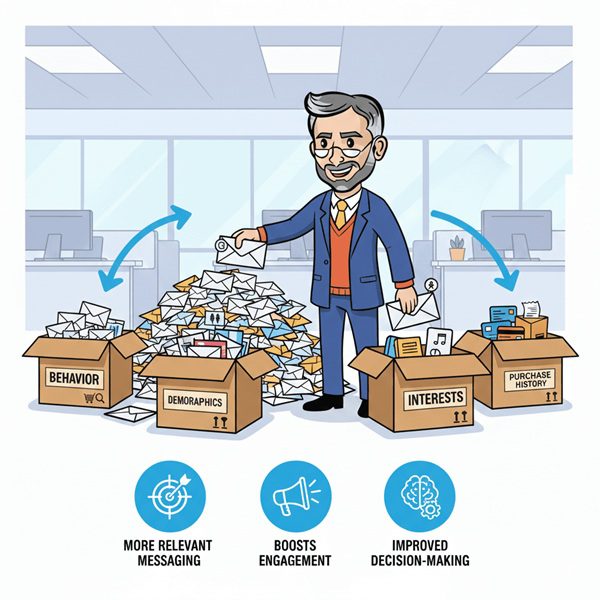
Modern email platforms that integrate with CRMs and ERPs make this easier than ever. You can sync product usage data, service history, and order behavior to build segments dynamically. A well-segmented list increases email relevance and improves open rates-one power management manufacturer saw a 48.6% open rate and 34.7% click rate on the first email of a loyalty program automation, far above typical baselines.
Choosing the Right Email Marketing Platform for a Manufacturing Business
Your email marketing platform is the backbone of every campaign, automation, and report. For a manufacturing business, platform choice matters because you need integrations that handle complex data (product families, configurations, service usage), support for long B2B sales cycles, and strong deliverability.
Must-have features to evaluate:
- Robust email automation workflows with triggers and branching
- Complex segmentation by role, vertical, lifecycle, and product line
- CRM setup and ERP synchronization so contact and order data drive personalization
- Dynamic content to show different sections based on segment or past behavior
- Clear call to action tracking tied to conversions (RFQs, demos, downloads)
- Deliverability tools: authenticated sending domains, reputation monitoring
- Security, data privacy, and regional data hosting options
Integration examples relevant to 2027 manufacturing: syncing with CRM platforms so purchase history drives email content, connecting with CPQ tools so configurator usage triggers follow-ups, and linking distributor portals for partner communications.
Start lean. If your list is in the hundreds, a basic tier with light marketing automation will work. As you scale to tens of thousands of contacts across multiple product lines and dealer networks, move to tiers that support advanced flows, dynamic content, and detailed attribution. Factor in onboarding costs, template creation, and integration effort. Also verify data ownership policies and security controls-global manufacturers face strict data residency requirements.
Creating Email Content That Engineers and Buyers Actually Read
Effective email marketing for manufacturers focuses on education and technical value, not fluffy copy. A strong content marketing for manufacturers strategy helps supply the technical resources needed for these campaigns. Your potential customers care about uptime, throughput, tolerances, safety compliance, and total cost of ownership. Recipients spend an average of 51 seconds reviewing an email campaign-you need to earn that time with content that answers real questions.

Core content types that drive engagement in the manufacturing industry:
- New product or feature releases with specs and technical differentiators
- Application stories showing before-and-after metrics (e.g., “cut changeover time by 32%”)
- Customer success stories and case studies demonstrating product performance
- Maintenance tips and preventive maintenance schedules
- Technical guides and how-to content for operators
- Industry insights: regulatory updates, market trends, raw material pricing
- Training and event invitations, including webinar registration
Manufacturers should provide technical resources like CAD files and product datasheets in emails where appropriate. Educating consumers through email content can build trust and encourage purchase decisions, especially across the long evaluation periods common in this sector.
Manufacturers are also advised to share case studies that demonstrate the success of their products-real numbers stand out.
Structure every email for skimmability: subheadings, short paragraphs, bullet points, and a single clear call to action. Clear calls to action should guide recipients toward the next steps in the purchasing process, whether that is downloading a spec sheet, requesting a quote, or scheduling a demo. Optimize layouts for mobile devices-plant managers and executives often check email on phones under spotty Wi-Fi. Effective email content should address audience pain points and provide value, not just announce company news.
Design, UX, and Technical Setup for High-Deliverability Emails
Clean design is not optional. Use brand-consistent colors, ample white space, and a clear visual hierarchy that guides the reader’s attention straight to your primary call to action. Avoid dense walls of text or cluttered layouts.
Keep email weight light. Many email recipients are on slow plant Wi-Fi or mobile networks-compress images, host assets externally, and link to landing pages instead of attaching heavy PDFs. This ensures emails are delivered successfully and render quickly.
Accessibility basics matter: readable font sizes, sufficient contrast, alt text for key visuals, and logical heading order. These steps create a positive user experience for everyone on your list.
On the technical side, authenticate your sending domain with SPF, DKIM, and DMARC. On the technical side, authenticate your sending domain with SPF, DKIM, and DMARC. Google’s email sender guidelines require SPF or DKIM authentication for all senders to personal Gmail accounts. Bulk senders must implement SPF, DKIM, and DMARC, along with additional requirements such as one-click unsubscribe for marketing messages.
Use a recognizable sender name (not “no-reply@”). Avoid spammy language and excessive caps. Regular list maintenance upholds deliverability standards-remove hard bounces, suppress inactive contacts after re-engagement attempts, and keep spam complaint rates low. Email deliverability depends on these hygiene practices.
Use preheader text strategically to complement different subject lines and boost open rates. A strong preheader acts as a secondary headline in crowded inboxes.
Email Automation Flows That Support the Manufacturing Sales Cycle
Marketing automation for manufacturing improves efficiency and saves time by keeping your brand in front of long-cycle opportunities without overwhelming the sales team. Automated email workflows support the long sales cycles typical in manufacturing, where deals can take months or years.
Essential automated sequences for manufacturers:
- Welcome series: Triggered on opt-in. Introduce your brand, share a resource, deliver a case study, invite deeper engagement.
- Post-trade-show follow-up: Triggered by badge scan or form fill at industry events. Deliver relevant content based on the products they showed interest in.
- Quote follow-up: Triggered when someone submits an RFQ but hasn’t purchased. Nurture with application stories and ROI data.
- New customer onboarding: Triggered on first order. Cover installation, training, spare parts, and service options.
- Maintenance and service reminders: Triggered by time since last service or seasonal windows. Drive spare parts and service revenue.
- Reactivation: Triggered when an account has not ordered in nine months or more. Re-engage dormant accounts with fresh content or offers.
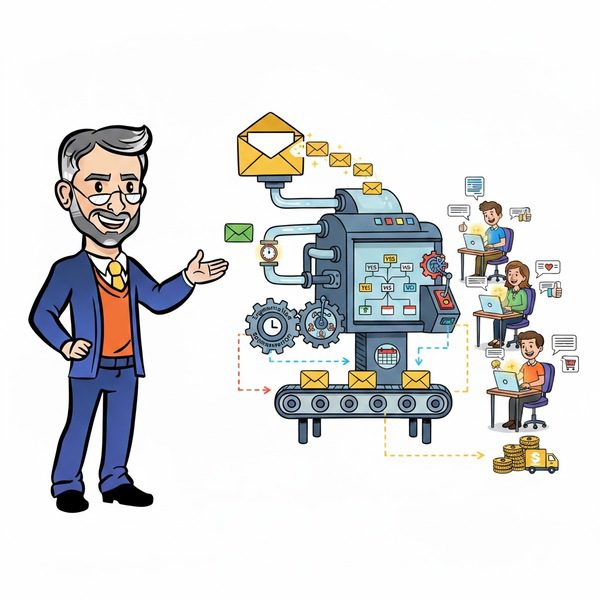
Automation allows for timely emails triggered by user actions-someone who clicks on equipment content gets a different follow-up than someone browsing parts. This behavior-based branching keeps automated campaigns feeling personal, not robotic. Email marketing automation can enhance lead nurturing processes by matching content to where each contact sits in the sales process.
Automated emails can increase conversion rates significantly. Start with one or two simple flows, measure results, and expand from there. Keep human oversight on sensitive communications like pricing or contractual terms.
Measurement, KPIs, and Continuous Optimization
Treat email marketing like any other critical manufacturing process: measured, reviewed, and improved over time. Email marketing allows for measurable results through analytics tools that connect campaign activity to business outcomes.
Key metrics to track:
- Delivery rate and bounce rate
- Open rate (benchmark: 23–37% for manufacturing)
- Click through rate (benchmark: 2.8–4.2%)
- Conversion rate to RFQ, demo, or spec download
- Revenue attributed to email campaigns
- Unsubscribe and spam complaint rates
Analyzing engagement metrics helps assess the impact of email campaigns on revenue. Set a practical review rhythm: weekly checks on campaign-level email marketing performance and quarterly strategic reviews across your whole email marketing strategy.
A/B testing helps determine what content resonates with your audience. Test different subject lines (benefit-driven vs. technical-term), different calls to action (“Request quote” vs. “Download spec sheet”), email length, and send times. A/B testing and performance metrics help optimize email campaigns for better results over time.
Feed insights back into other marketing efforts. Topics that earn strong engagement in email often make strong blog content, paid search copy, and sales collateral. Build dashboards that support measuring marketing ROI and show how email contributes to pipeline and revenue—not just opens and clicks. Analytics tools enable tracking of email campaign success at the level that matters to CEOs and sales leaders.
Common Email Marketing Mistakes Manufacturers Should Avoid
Most manufacturing companies operate with small marketing teams, legacy CRM data, and a heavy reliance on referrals and trade shows. These constraints lead to predictable mistakes.
Frequent issues that undermine email marketing efforts:
- Irregular sends: Going months without contact, then blasting. Consistency builds a consistent presence.
- Every email is a sales pitch: Subscribers disengage when they never receive educational resources or quality content.
- Ignoring segmentation: Sending high-level branding emails to maintenance technicians who need troubleshooting content, for example, wastes everyone’s time.
- Generic sender addresses: “no-reply@yourcompany.com” feels impersonal and hurts reply rates.
- No clear call to action: If the reader does not know what to do next, nothing happens.
- Never cleaning the list: Dead addresses and unengaged contacts drag down deliverability for everyone.
- Skipping compliance: Missing unsubscribe links or unclear opt-in language invites legal risk.
- No measurement: If you do not track key metrics, you cannot tell what is working or where to spend money improving.
Correct each mistake by referring back to the sections above: set a strategy, segment your list, clean regularly, and build automation that keeps subscribers engaged without manual effort. Gradual improvement matters more than launching a “perfect” campaign that never ships.
Why Choose a Specialist Partner for Manufacturing Email Marketing

Marketing for manufacturers involves challenges that generalist agencies rarely understand: long technical sales cycles, dealer network dynamics, heavy equipment complexity, and regulatory requirements specific to the manufacturing sector. A specialist partner brings deep familiarity with the buyer personas-engineers, plant managers, procurement managers-and knows how to address common challenges with content that resonates.
Look for partners who can connect email metrics to pipeline and revenue, not just open rates. They should have experience with CRM and marketing automation tools used in the manufacturing industry, and they should be able to show examples of email campaigns that improved RFQ volume, reduced quote follow-up time, or increased parts and service revenue. The ability to support related digital marketing efforts-SEO, paid search like Google Ads, conversion optimization-amplifies email results and creates a consistent presence across channels.
Ask potential partners for case studies. If they cannot show measurable outcomes from previous work with manufacturing companies, keep looking. A good partner treats email as a powerful tool within a broader revenue strategy, not an isolated tactic.
Next Steps: Putting Your Email Marketing Strategy Into Action
The playbook is straightforward: start with clear goals, build and segment a quality list, choose the right email marketing platform, create valuable content grounded in technical reality, set up email automation, and measure rigorously. Email marketing is the long game-consistent, measured, and refined over time.
Pick one priority improvement and implement it within the next 30 days. Launch a welcome sequence. Clean your list. Segment by role. Whichever action you choose, commit to it and measure the result. Then draft a simple 90-day email marketing roadmap aligned with your broader manufacturing marketing strategy, sales targets, upcoming product launches, or key industry events.
If you want help auditing your current email campaigns or designing a new email marketing strategy built around your manufacturing business, reach out to a specialist who understands the manufacturing sector. A focused audit can reveal where you are leaving pipeline and revenue on the table-and where a few targeted improvements will drive the most impact. Strong email marketing will carry manufacturers through evolving buyer behavior and digital marketing changes well beyond 2027.
FAQs About Email Marketing for Manufacturers
How often should a manufacturing company send marketing emails?
A monthly newsletter works as a baseline for your broader audience. Layer in targeted campaigns tied to product launches, trade shows, and budget cycles-two to three per quarter for each vertical or segment. Automated campaigns (welcome, RFQ follow-up, service reminders) fire based on behavior, not a calendar. The goal is to keep subscribers engaged and your brand top of mind without overwhelming busy engineers and buyers. Test cadence and adjust based on engagement data. If unsubscribes spike, pull back. If click rates hold steady, you have room to send more relevant emails.
What types of email campaigns work best in the manufacturing industry?
Educational campaigns, application-focused case studies, maintenance tips, and equipment lifecycle content consistently outperform hard-sell blasts. Trade-show follow-ups, spec sheet delivery, and periodic industry insights digests also perform well. A successful email marketing campaign always includes a clear call to action-whether it drives an RFQ, a demo request, or a conversation with your sales team.
Can email marketing really generate revenue for complex, long sales cycles?
Yes. Email supports multi-stakeholder decisions by repeatedly addressing technical, financial, and operational concerns over months or years. One manufacturing SaaS platform used targeted email sequences over 14 months to generate 238 qualified meetings and $4.3M in pipeline. Consistent nurture through the sales process keeps qualified leads warm until the buying window opens. Track pipeline and closed-won deals by connecting your CRM with your email marketing platform to see concrete revenue impact and more sales over time.
Which metrics should manufacturers prioritize when evaluating email performance?
Focus on business metrics over vanity metrics. Opens and clicks are useful diagnostics, but the numbers that matter are conversions to RFQs or demos, revenue influenced, and pipeline contribution. Build a small dashboard tracking open rate, click through rate, conversion to key actions, and influenced revenue. Compare email marketing performance by segment-distributors vs. end users, engineers vs. procurement managers-to spot where future campaigns should focus.
Do smaller manufacturers with no dedicated marketing team still benefit from email?
Absolutely. Even a basic program-quarterly newsletters, simple automation after RFQ submissions, annual maintenance reminders-helps a small job shop or regional OEM build brand awareness and maintain relationships between orders. Modern email platforms offer templates and drag-and-drop builders that save time and reduce technical overhead. You do not need a large marketing team to send personalized emails that drive lead generation and keep your manufacturing business visible.
How does email marketing integrate with sales and account management?
Email activity data-opens, clicks, spec downloads-feeds directly into lead scoring and helps the sales team prioritize outreach. For example, a rep can receive alerts when a dormant prospect starts engaging with equipment upgrade content, enabling timely follow-up. This creates a direct line between digital marketing activity and the sales process. Shared goals and feedback loops between sales and marketing teams ensure that email marketing efforts translate into real conversations, not just website traffic.