

Every industrial marketing case study worth reading in 2027 starts with the same uncomfortable truth: the way heavy equipment buyers find, evaluate, and choose suppliers has fundamentally changed. With about 94% of B2B buyers now researching products online before ever contacting a sales rep, visibility in digital channels is vital for modern industrial equipment marketing. Industrial buyers prefer self-directed digital research before engaging sales representatives, and manufacturers who ignore that reality are losing projects they never even knew existed.
This particular industrial marketing case follows a Midwestern bulk material handling equipment manufacturer that transformed its outdated website and fragmented marketing into a 7-figure revenue engine over 18 months. The company went from fewer than 10 monthly form fills to a steady flow of qualified RFQs, closed over $3.1M in digitally sourced revenue, and cut its dependence on trade shows and top-account concentration. The article walks through the real timeline, proven tactics, numbers, and lessons learned so readers running industrial companies with complex, engineer-driven sales cycles can model a similar lead generation system. Below is a roadmap of everything we will cover.
Table of Contents
- Company Background & Market Context
- The Industrial Marketing Challenges Before the Engagement
- Goals & Success Metrics for the Industrial Marketing Program
- Market Research & Buyer Insight: Understanding Industrial Customers
- Digital Marketing Strategy & Channel Mix for Industrial Buyers
- Content Strategy & Creation: Turning Expertise into Lead Magnets
- SEO, Local SEO & Conversion Optimization: From Traffic to RFQs
- Industrial Marketing Results: Pipeline, Revenue & Sales Alignment
- Key Lessons for Industrial Businesses Planning a Similar Marketing Case
- Why Choose a Specialized Industrial Marketing Partner
- Next Steps: Turning Your Own Industrial Marketing Case into a Growth Engine
- Frequently Asked Questions About Industrial Marketing Case Studies
Company Background & Market Context
The company at the center of this case is a privately held bulk material handling equipment manufacturer based in Ohio, founded in 1993. It serves aggregates, recycling, and mining operations across the Midwest and Great Lakes region. Its product line includes custom conveyors, radial stackers, feeders, and crushing and screening systems sold through a hybrid direct-sales and dealer model, with average project values ranging from $250,000 to $1.2M. Industrial marketing involves fewer but larger markets than consumer marketing, and this company’s products are a textbook example-each sale requires engineering review, custom quoting, and often months of specification work.
By 2024, market conditions were shifting. Long quoting cycles stretched further as procurement teams added approval layers. Competition from European OEMs increased. Dealer consolidation raised expectations for better digital support. The company’s starting marketing situation was typical of many manufacturers: an outdated 2017 website, no documented content strategy, minimal analytics, and heavy reliance on trade shows, referrals, and repeat customers. The sales team ran on spreadsheets and disconnected email threads with no CRM or formal lead generation system. Many industrial businesses are shifting from product-focused promotions to data-driven marketing, but this company hadn’t made that transition yet.
The Industrial Marketing Challenges Before the Engagement
Despite strong product quality and a solid reputation in its region, several concrete problems were holding the company back from growth.

- The website generated fewer than 10 form fills per month, and almost none qualified as RFQ-ready leads.
- There was no alignment between marketing and sales teams. Sales reps didn’t trust website leads, and marketing had no visibility into what happened after a form submission. Aligning sales and marketing improves lead generation effectiveness in B2B, but no feedback loops existed.
- Trade shows in 2022–2024 produced unpredictable ROI and rising costs, with booth fees, travel, and display expenses climbing every year.
- Messaging was generic-no targeted messaging for engineers versus purchasing versus plant managers, making it impossible to address the pain points of each audience.
- Zero local SEO optimization existed across dealer locations and rental partners.
- The company depended on its top three accounts for over 50% of annual revenue.
Revenue was flat between 2021 and 2024. The pipeline was stagnant. Establishing feedback loops between sales and marketing can enhance campaign effectiveness, but those loops simply did not exist. The main objective that framed this industrial marketing case was clear: double qualified opportunities in 12 months without adding more shows.
Bonus tip: a modern B2B sales funnel helps manufacturers connect marketing activities with qualified opportunities and revenue growth.
Goals & Success Metrics for the Industrial Marketing Program
Clear, measurable goals are essential in any industrial marketing case study, especially when key decision makers across ownership, the sales team, and engineering all need to agree on what success looks like. Effective industrial marketing connects strategies to measurable customer outcomes, not vanity metrics.
In January 2025, the team set these targets:
- Increase marketing sourced pipeline from roughly 15 opportunities per quarter to 60+ by Q1 2026.
- Grow website-sourced revenue to at least $2M annually within 18 months.
- Lift average monthly inbound RFQs from 8 to 40, focused on core product lines.
- Improve lead-to-opportunity conversion rates from 9% to at least 18%.
- Establish brand visibility in regional search results for specific keywords like “conveyor manufacturer Ohio” and “aggregate conveyor systems Midwest.”
The measurement stack included Google Analytics 4, call tracking, and a robust CRM (HubSpot) to streamline marketing and sales tasks with deal-level attribution tied to quote numbers. Website traffic and downloads would directly connect to sales pipeline progression. Leadership agreed that pipeline health and quality mattered as much as immediate revenue, given that industrial buying cycles run 6–18 months.
Market Research & Buyer Insight: Understanding Industrial Customers
Market research is non-negotiable in industrial marketing. Technical decision makers, derived demand, and long-term relationships mean you cannot guess your way to effective content creation. Organizations should focus on precise targeting and technical credibility in marketing, and that starts with understanding potential customers deeply.
In Q1 2025, the team completed several research tasks:
- 15 structured interviews with plant managers, maintenance supervisors, and project engineers at aggregate and recycling facilities in Ohio, Indiana, and Pennsylvania.
- Win/loss analysis of 30 closed deals from 2022–2024 to identify patterns in why projects were won or lost.
- A competitor audit of 6 regional and 3 national equipment manufacturers, focusing on messaging, content depth, and local SEO coverage.
- Review of historical RFQs and RFPs to map common specs, project sizes, and decision criteria.
Key insights emerged that shaped the entire digital marketing strategy:
- Engineers were frustrated by generic brochures and wanted dimensioned drawings, case studies, and layout examples. Educational content enhances buyer confidence before sales conversations.
- Procurement teams cared about documented ROI and lifecycle cost, not just initial bid price.
- Many prospects discovered vendors via application-specific search terms rather than brand names.
- Building trust through educational content is essential for long-cycle buyers, and educational resources can serve as a central hub for B2B buyers during longer sales cycles.
These findings directly shaped content strategy, landing pages, and the company’s products positioning across the new website.
Digital Marketing Strategy & Channel Mix for Industrial Buyers
The integrated industrial marketing strategy launched in April 2025 combined inbound marketing, lead generation, and targeted digital advertising into a unified marketing plan. SEO can improve website visibility and attract organic traffic over time, while paid search advertising can quickly reach target buyers during high-intent moments. SEO builds credibility while PPC captures immediate buyer intent, and merging SEO with paid advertising increases lead generation effectiveness.
Effective industrial inbound marketing attracts qualified buyers through technical content, SEO, and targeted lead generation.
The core channel mix:
- A new website rebuilt as the central sales tool with clear site architecture, product hierarchy, application pages, and RFQ paths.
- An SEO strategy and local SEO campaign targeting both generic and application-specific industrial keywords across the Midwest.
- A technical content strategy focused on blogs, case studies, and downloadable design guides.
- Email nurturing sequences aligned to the buyer’s journey for long, engineer-driven decision making processes.
- Limited, highly targeted SEO PPC campaigns for high-intent RFQ terms.
- Account-based marketing to target key accounts and specific buyer roles at priority plants and operations.
Trade shows and plant visits were kept but reframed as part of the inbound marketing funnel with pre-show content and post-show nurturing. Integrated campaigns provide consistent information to industrial buyers across multiple touchpoints.

In comparable programs, inbound marketing grew online leads by 150% in one month. The strategy was built for industrial businesses with 6–18 month sales cycles and deal sizes above $150,000, focusing on marketing sourced pipeline value rather than vanity metrics.
A similar approach to website design for heavy equipment dealers can create clearer conversion paths and generate qualified RFQs.
Content Strategy & Creation: Turning Expertise into Lead Magnets
The content strategy was built directly from market research and RFQ analysis. Content marketing establishes companies as industry experts and boosts awareness, and creating technical content establishes expertise and boosts conversion rates. The team prioritized five content types:
- Application pages (e.g., “Conveyor Systems for Road Salt Storage Domes,” “Recycling Yard Conveyor Retrofits”) with CAD images, layouts, and spec sheets. Integrating CAD downloads and product configurators can improve user experience on product pages, and interactive digital tools enhance credibility and streamline buyer research.
- Deep-dive industrial marketing case studies featuring real projects with tonnage, throughput gains, downtime reductions, and photos.
- A quarterly “Engineer’s Field Guide” PDF on topics like dust control and transfer point design, offered as gated content behind lead forms. Transitioning from gated content to technical transparency improves visibility during early research phases, so the team also published ungated summaries.
- A blog series answering long-tail questions pulled from sales and support emails.
- Short technical email “micro-lessons” for lead nurturing sequences. Video content was also introduced to effectively demonstrate product value and applications.
Before the engagement, the company had 3 generic product PDFs and one outdated brochure. After: 40+ new content pieces added between June 2025 and March 2026, with at least 12 focused case studies. Self-service tools helped buyers automate supplier shortlisting processes, and investing in website development enhanced operational reliability perceptions. Content was structured to nurture leads through awareness, consideration, and decision stages, guiding visitors through the buyer’s journey toward RFQ submission.
SEO, Local SEO & Conversion Optimization: From Traffic to RFQs
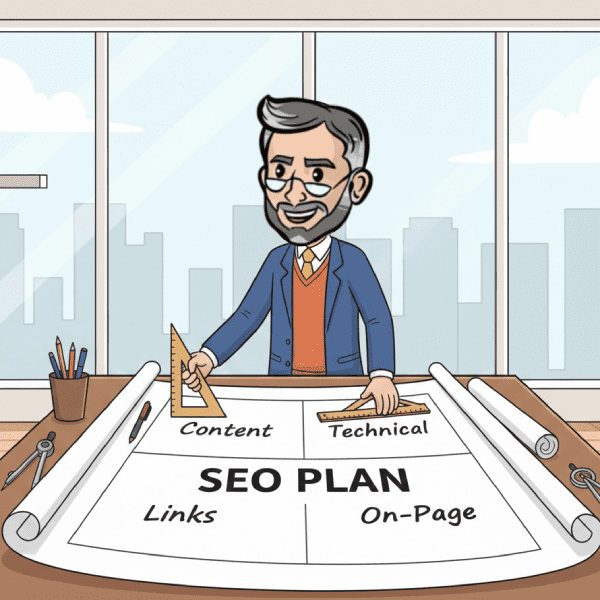
Industrial marketing efforts cannot stop at content creation. SEO and conversion optimization are what convert organic traffic into qualified opportunities. SEO can improve a website’s SERP rankings and visibility, and effective SEO strategies include keyword research and technical audits.
The SEO work completed between May–October 2025 included:
- A technical SEO audit to fix crawl issues and slow page templates, carried into the new website build.
- Keyword research and mapping covering core terms and bottom-funnel RFQ phrases using specific keywords tied to applications.
- On-page optimization including descriptive H1s, meta descriptions, and internal linking between applications, industries, and case studies.
The local SEO component included optimizing 20+ dealer and branch Google Business Profiles across Ohio, Indiana, Michigan, and Pennsylvania. The team maintained consistent NAP data, created localized landing pages, and encouraged reviews from plant managers.
Conversion rate optimization included replacing generic “Contact Us” buttons with targeted CTAs like “Upload Your RFQ.” The team also added short forms for drawings and photos, testimonials, spec badges, safety certifications, and quick-quote tools. Similar SEO and PPC strategies generated high-quality leads for companies like Wyatt Seal, Inc.
Results from this phase: organic traffic increased over 110% between July 2025 and July 2026. Website-wide conversion rates also improved from 0.6% to 2.4% for RFQ-related actions. In fact, a NIST case study on manufacturing website improvements reported a 30% increase in online quote requests.
Industrial Marketing Results: Pipeline, Revenue & Sales Alignment
What did this industrial marketing case achieve in concrete business terms by mid-2026? The answer is measurable results across every metric that matters to an industrial business.
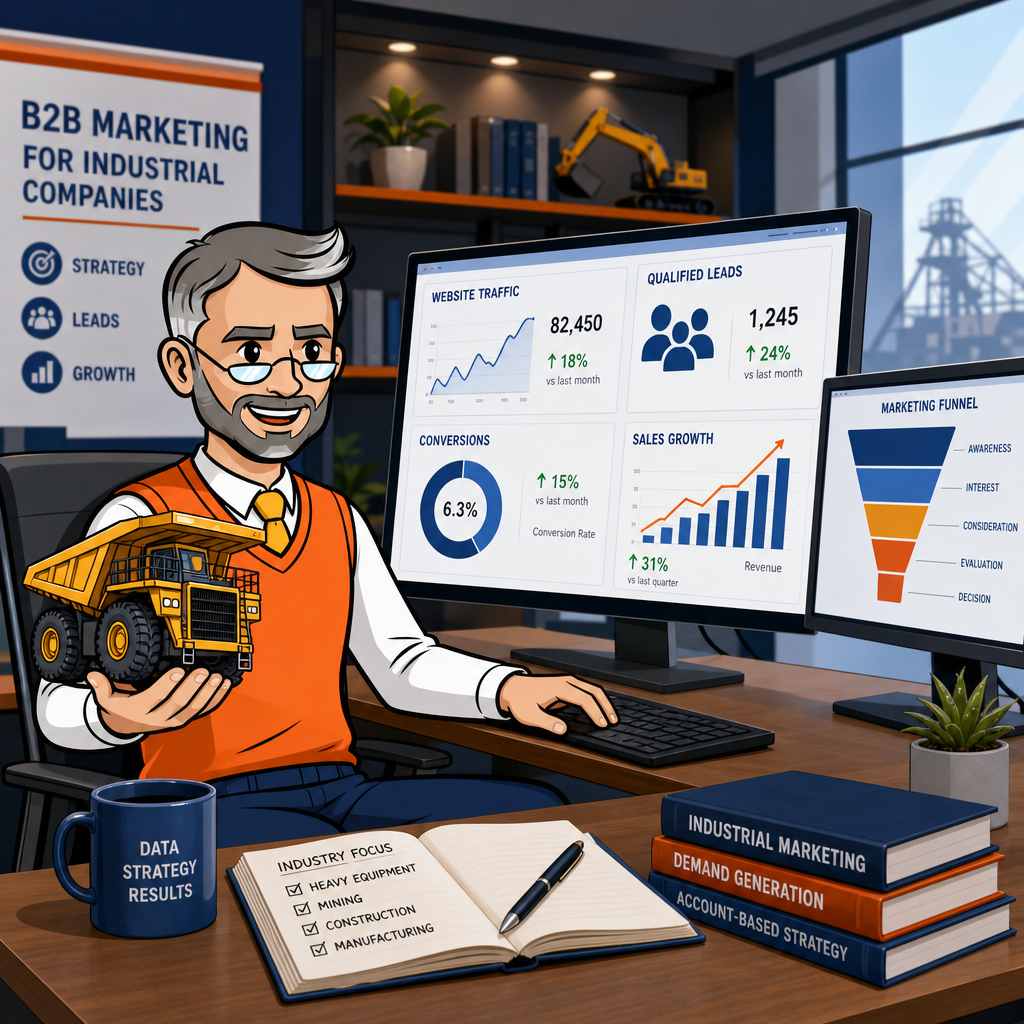
- Marketing-sourced opportunities increased from roughly 60 per year in 2024 to 230 in the 12 months ending June 2026.
- Inbound RFQs via the website grew from 8 per month in Q1 2025 to an average of 43 per month in Q2 2026.
- Closed-won revenue attributed to digital channels exceeded $3.1M between January 2025 and June 2026, including three projects over $500,000 each.
- Personalized email campaigns nurtured leads and guided them to close, with email lead nurturing helping convert strong leads into customers. Lead nurturing converted nurtured leads into significant contracts, shortening the average sales cycle by roughly 22% for repeatable system packages.
- Local SEO generated first-time inquiries from at least 17 new plants and quarries that had never engaged with the brand.
- Overall website conversion rates improved 4x, while lead-to-opportunity rates nearly doubled from 9% to 17%.
- Data and automation improved marketing personalization for industrial buyers across the funnel.
Understanding how equipment companies measure marketing ROI helps connect campaign performance with pipeline growth and revenue.
Comparable programs have delivered impressive results. A website overhaul generated 407 MQLs and 230 SQLs in six months, while paid ads produced 134 leads for MūL Technologies. Inbound marketing generated $800,000 for a generator distributor, and American Piping Products doubled its inbound leads. Falcon Structures gained 738 MQLs and 31 customers, while Gordon Flesch Company generated over $5 million in new business. Strouse Corporation increased quote requests by 90%, and another industrial marketing case study reported 650% growth in contact generation.
Sales and marketing alignment also improved. The sales team shared success stories and photos for new case studies, while monthly pipeline reviews connected marketing campaigns to quotes and orders. Improved lead nurturing increased repeat orders by 18%, supporting customer retention and sustainable growth. The content also highlighted industrial marketing’s focus on quality and effective manufacturing processes.
Key Lessons for Industrial Businesses Planning a Similar Marketing Case
This industrial marketing case study is not just a success story-it is a blueprint other manufacturers and equipment dealers can adapt. With 94% of B2B buyers researching products online before buying, the fundamentals apply regardless of product category.
Key lessons:
- Deep market research with real customers beats guessing what new content to create.
- Application-specific pages and case studies outperform generic product pages for lead generation almost every time.
- Local SEO is essential when dealers, service techs, and field offices play a role in the customer experience.
- Slow buying cycles make email and content nurturing critical-don’t expect instant RFQs from a single visit.
- Tracking pipeline and revenue, not just traffic, earns long-term buy-in from leadership and the sales team.
- Combining inbound marketing with targeted outbound (email follow-ups to lapsed RFQ contacts) multiplies results and creates new opportunities.
Proper CRM setup for heavy equipment sales teams improves lead tracking, sales alignment, and customer relationship management.
Start with one high-priority product line or region rather than trying to transform everything at once. Use that focus area to prove the true value of digital marketing strategy before expanding.
Why Choose a Specialized Industrial Marketing Partner
Industrial marketing for equipment manufacturers and dealers is fundamentally different from generic B2B marketing. It requires understanding technical language, safety and compliance concerns, plant access logistics, and the reality of long sales cycles and complex decision making processes.
When evaluating an industrial marketing partner, look for:
- Demonstrated experience producing industrial marketing case studies for manufacturers, OEMs, and distributors.
- Ability to translate engineer-speak into clear, accurate content without oversimplifying.
- Expertise in SEO, local SEO, and content strategy for industrial businesses and long-tail, application-driven searches using thorough keyword research.
- Strength in tying digital advertising and marketing strategies to sales process, CRM management, and revenue reporting.
- Familiarity with long RFQ cycles, bid processes, and dealer network dynamics.
- Willingness to walk factory floors, speak with engineers, and review real drawings to build solutions that serve prospects and clients alike.
A strong partner should create growth by connecting current marketing activity to pipeline and revenue, not just delivering more leads or social media impressions.
Next Steps: Turning Your Own Industrial Marketing Case into a Growth Engine
The path from trade show dependency and stagnant pipeline to a predictable digital revenue engine is methodical, not magical. This case proves that disciplined industrial marketing, grounded in real case studies and buyer research, can transform both pipeline and revenue for manufacturers of any size.
Here is a simple roadmap:
- Identify 3–5 past projects with strong technical and business outcomes.
- Interview internal sales and engineering stakeholders to surface the full story and data.
- Prioritize 1–2 company’s products or applications where better inbound lead generation would have the greatest impact on growth.
- Map out a basic content strategy-case studies, application pages, FAQs-and connect it to CRM-based tracking.
- Decide whether to build in-house capabilities or partner with a specialist in industrial marketing.
Audit your current website and content for industrial readiness. Organize your first 2–3 industrial marketing case studies within the next 60 days. And if you want expert guidance from a team that understands the realities of equipment manufacturing processes, dealer networks, and complex sales cycles, reach out to Pro Equipment Marketing to review your situation, explore your options, and outline a realistic 12–18 month digital marketing strategy built for predictable, measurable lead generation and revenue growth-not just more marketing activity.
Frequently Asked Questions About Industrial Marketing Case Studies
These FAQs address common questions from manufacturers and equipment companies exploring industrial marketing case studies as part of their growth strategy.
How long does it take for an industrial marketing case study strategy to show results?
Early traffic and lead quality improvements are often visible within 3–6 months, but full pipeline and revenue impact typically takes 12–24 months due to long industrial buying cycles. In this case, the strategy launched in April 2025, and major revenue impact materialized by mid-2026. Quick wins like better RFQ quality and higher email engagement can appear earlier and should be tracked.
What data do I need to create a strong industrial marketing case study?
Essential data includes project type, industry, dates, equipment scope, baseline versus improved performance (throughput, uptime, maintenance cost), and revenue impact. Capture internal metrics like quote value, margin, and sales cycle length before and after marketing changes. Anonymization works when customers won’t allow plant names, as long as performance data and industry context are preserved.
How do industrial marketing case studies support lead generation?
Case studies build trust by showing real-world results for similar plants, materials, and operating conditions. They can be used on application pages, in sales presentations, in email nurturing sequences, and as downloadable PDFs behind lead forms. Highly specific case studies tied to material type, capacity, or layout constraints generate higher-intent leads than generic project profiles.
What’s the difference between a marketing case study and a standard project profile?
Project profiles summarize what was built. An industrial marketing case study highlights the business problem, decision process, solution, and measurable results. Include clear before/after metrics, quotes from plant staff, and timeline details. Structure every case around challenge, approach, solution, and results.
Can small or mid-sized industrial businesses benefit from case-study-driven marketing?
Absolutely. Even regional fabricators, job shops, and small OEMs can generate more leads with 3–5 solid case studies tied to their best-fit projects. One well-crafted case study can anchor an entire content strategy and lead generation funnel for a key product line. The primary investment is time and access to project details, not huge paid media budgets.
How many case studies do I need before investing in a broader digital marketing strategy?
Starting with 2–4 detailed, high-quality case studies covering different industries or applications is enough to launch a strong industrial marketing program. These can be repurposed into blogs, landing pages, social media posts, and email series to support a full content strategy. Add new case studies quarterly as projects are completed, building a living library.
What internal resources are required to support an industrial marketing program like this?
Typical internal roles include a sales or engineering “champion” for technical review, someone to gather project data and photos, and leadership support for sharing performance metrics. The company in this case committed roughly 4–6 hours per month from engineering and sales, working closely with their external partner to keep content accurate. External partners handle writing, SEO, design, content creation, and marketing automation once internal experts provide raw information and approval.