
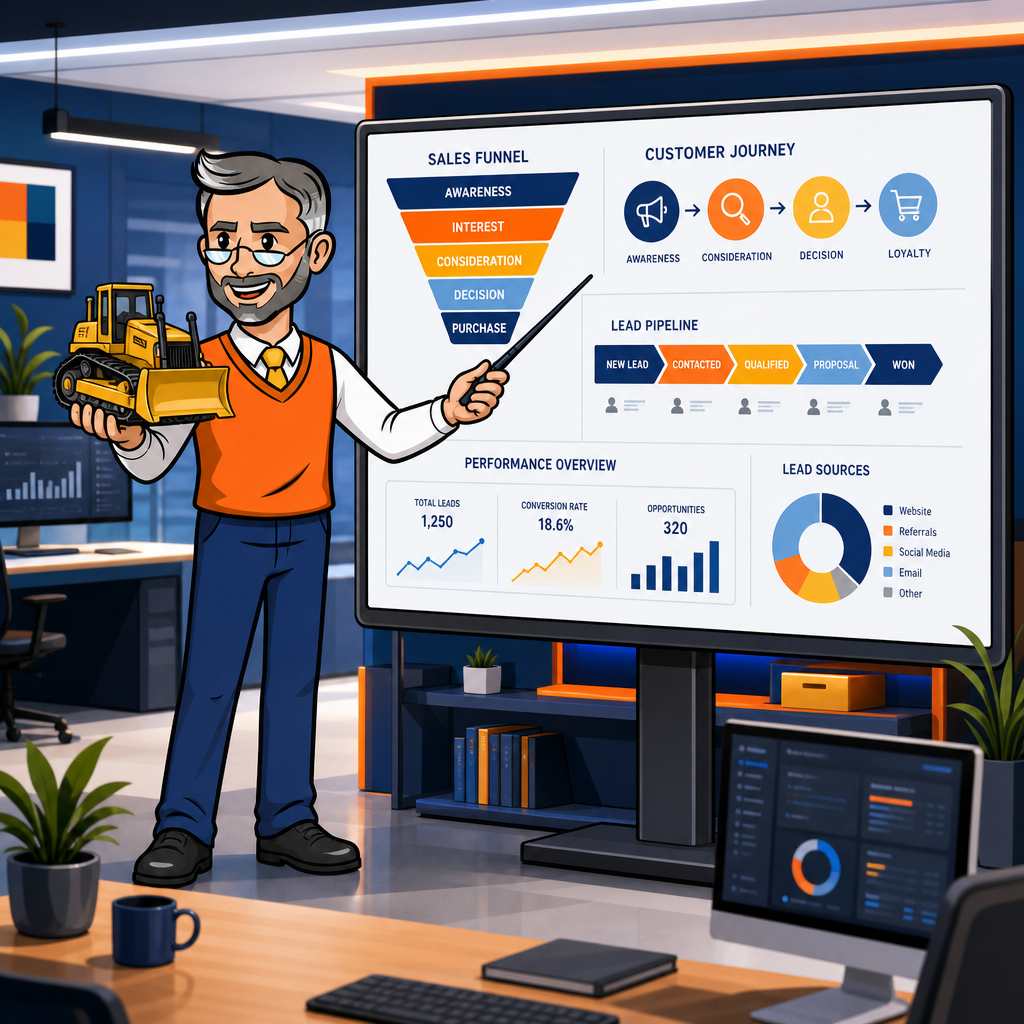
If your manufacturing company still relies mainly on trade shows, word-of-mouth referrals, and distributor relationships to fill the pipeline, you’re missing significant revenue opportunities. Today, technical buyers complete about 60% of their research online before contacting suppliers, making a strong digital presence essential. Companies that appear early in this research process are the ones winning requests for quotes (RFQs).
A manufacturing marketing agency specializes in helping industrial companies generate demand, build digital visibility, and convert technical prospects into qualified leads. Their services include lead generation, web development, content marketing, SEO, marketing automation, CRM integration, paid advertising, and sales enablement—all tailored to the complexities of the manufacturing sector.
Marketing in manufacturing differs from general B2B marketing due to long sales cycles that can stretch from 6 to 18 months or more, complex products, and multi-stakeholder buying committees including engineers, procurement, operations, and finance. Accuracy is critical, as even small errors in technical details can damage credibility.
This guide highlights top manufacturing marketing agencies in 2027 and offers a practical framework for choosing the right partner based on your business model, whether you are an OEM, contract manufacturer, equipment dealer, or distributor.
Table of Contents
- How We Evaluated Top Manufacturing Marketing Agencies
- Best Manufacturing Marketing Agencies in 2027 (By Strength)
- What Makes Industrial Marketing Different From Other B2B
- Key Services the Best Manufacturing Marketing Agencies Provide
- How to Choose the Right Manufacturing Marketing Agency for Your Business
- Common Mistakes Manufacturers Make When Hiring Marketing Agencies
- Measuring Success: KPIs and ROI for Industrial Marketing Programs
- When It’s Time to Bring in a Specialized Manufacturing Marketing Agency
- Why Choose Our Agency to Grow Your Manufacturing Revenue
- Next Steps: How to Engage a Manufacturing Marketing Agency
- FAQs About Manufacturing Marketing Agencies
How We Evaluated Top Manufacturing Marketing Agencies
Ranking high on Google doesn’t make an agency qualified to serve industrial clients. Our evaluation focused on agencies with a proven track record of generating pipeline and revenue for industrial companies and manufacturing clients-not just traffic or social impressions.
Here’s what we looked at:
- Industrial focus and technical expertise. Does the agency specialize in technical industries like heavy equipment, industrial automation, process equipment, or life sciences manufacturing? Agencies should demonstrate measurable results in industrial marketing, not just claim broad B2B experience.
- Case studies with pipeline impact. We prioritized agencies that publish real outcomes: qualified RFQ growth, revenue from new accounts, and pipeline contribution. For example, one agency documented $4.5M in RFQs within six months for a plastics manufacturer. In addition to that, a NIST manufacturing case study documented $250,000 in increased sales following marketing and sales strategy improvements for an industrial machinery manufacturer.
- Core capabilities. We evaluated depth in content marketing, industrial marketing strategy, web development for RFQ-driven sites, SEO and AI search optimization, marketing automation, and sales enablement content.
- Fit with long B2B sales cycles. Agencies must understand dealer and distributor channel models, multi-stakeholder buying committees, and nurture programs that span months-not just quick-win campaign tactics.
- Geographic and company-size range. We considered agencies serving SMB manufacturers through global industrial companies, OEMs, distributors, and equipment dealers across North America and international markets.
In fact, manufacturing marketing agencies should have proven B2B experience and a deep understanding of how industrial buyers actually make purchasing decisions.
Best Manufacturing Marketing Agencies in 2027 (By Strength)
No single agency is “best” for every manufacturing business. The right fit depends on whether you need account-based marketing for named enterprise accounts, search optimization for a catalog-heavy distributor site, or technical content marketing that resonates with engineers. Here are agencies recognized for specific strengths.
Gorilla 76 – Best for Content-First Growth with OEMs and Custom Machine Builders
- Focuses on OEMs, custom machine builders, and robotics integrators
- Known for editorial-quality technical storytelling and long-cycle content strategies
- Full-scale programs typically run $200,000–$300,000 per year inclusive of agency fees and media
- Best fit for manufacturers needing to build authority with engineers over time
Industrial Strength Marketing (INDUSTRIAL) – Best for Full-Service Industrial Strategy
- Nashville-based, serving clients like ABB/Baldor, Mitsubishi Electric, and Schneider Electric
- Handles demand generation, workforce recruitment, distributor enablement, and brand strategy
- Particularly strong in brand positioning for companies undergoing M&A or rebranding
- Serves mid-market to enterprise industrial manufacturers
TREW Marketing – Best for Inbound Marketing to Engineers
- Specializes in engineering, automation, and robotics companies
- Deep expertise in inbound marketing, content strategy, and CRM nurture programs
- Ideal for manufacturers ready to invest in sustained thought leadership for technical audiences
Altitude Marketing – Best for Translating Complex Technical Products Into Clear Messaging
- Full integration across branding, web development, SEO, SEM, and trade show support
- Publishes retainer tiers (approximately $9,500–$16,000+/month), with roughly 80% of clients staying three years or more
- Excels at making scientific or specification-heavy products accessible to multiple buyer personas
Kula Partners – Best for Account-Based Marketing in Niche Industrial Markets
- Precision targeting of high-value named accounts rather than volume lead generation strategies
- Services include ICP development, territory planning, and account-based content
- Suited for manufacturers whose growth depends on winning a defined set of enterprise accounts
Weidert Group – Best for HubSpot-Centric Inbound and Sales Enablement
- Strong fit for manufacturers already on or migrating to HubSpot
- Builds inbound engines integrated with sales enablement and trade show follow-up
- Kuno Creative, a similar agency in this space, emphasizes ongoing performance monitoring for marketing strategies
TopSpot – Best for SEO and Conversion Optimization on Large Catalog Sites
- Specializes in digital marketing services for SKU-heavy distributors and OEMs
- Proven results improving rankings, leads, and traffic on complex industrial sites
Other notable results across the industry: Southern Metal Fabricators saw a 222% year-over-year increase in leads. Chemical Concepts achieved a 104% increase in monthly website traffic. Amerline saw a 450% increase in website sessions through SEO. Belkins campaigns deliver 120% of KPI goals on average. GrowthHive helps clients track and refine sales for measurable ROI.
What Makes Industrial Marketing Different From Other B2B
Industrial marketing isn’t just “B2B marketing with harder products.” The differences are structural, and they change everything about how you plan, execute, and measure.
Manufacturing sales cycles often span months and involve multiple decision-makers. B2B sales cycles average two months or more, and in heavy equipment or engineered systems, they frequently stretch to 12–24 months. According to Gartner research, 74% of B2B buying teams experience unhealthy conflict, reinforcing the need for messaging that addresses multiple stakeholders.

Manufacturing buyers often include engineers and procurement managers in the decision-making process, alongside operations, safety, and finance stakeholders. A content piece that wins over an engineer may do nothing for the CFO evaluating total cost of ownership.
Manufacturers face challenges reaching hard-to-reach audiences. Limited market size complicates traditional advertising efforts-you can’t run a broad consumer campaign to reach the 200 plant managers in North America who specify your type of conveyor system. Manufacturers often struggle to reach potential customers through traditional means, which is why targeted campaigns and personalized outreach are essential.
Industrial marketing also demands technical expertise to translate specs, performance curves, certifications, and standards into benefits that resonate with both technical and executive audiences. Then layer in global supply chains, dealer and distributor channel models, and regulatory requirements in sectors like chemicals, food processing, mining, and life sciences-and it becomes clear why generalist digital marketing strategies fall short.
In addition, effective manufacturing branding helps industrial companies communicate technical expertise and differentiate themselves in competitive markets.
Key Services the Best Manufacturing Marketing Agencies Provide
Top industrial marketing agencies function as strategic growth partners, covering everything from brand awareness metrics through demand generation, sales enablement, and revenue attribution. Here are the core services that matter most.
Industrial web development and conversion-focused website strategy. Websites for industrial companies must support RFQs, distributor lookups, spec sheets, CAD/BIM downloads, and equipment configurators. Web design is important for improving user experience and optimizing product data accessibility in industrial marketing. UX should be tuned for engineers and procurement teams who need fast answers, not flashy animations. Strategic manufacturing website design also helps improve technical content accessibility and convert website visitors into qualified RFQs.
SEO, AEO, and GEO for manufacturers. Search optimization means targeting specification-stage and application-stage keywords-queries like “stainless steel screw conveyors for food processing.” SEO strategies can boost website traffic by over 200%, and SEO and content marketing are vital for attracting technical buyers. In 2027, agencies must also optimize for AI search experiences, ensuring content surfaces in AI Overviews and generative search engines. Multi-location and multilingual considerations matter for global plants and dealer networks. A comprehensive manufacturing SEO strategy allows industrial companies to target application-specific searches and attract buyers researching technical solutions.

Content marketing and technical thought leadership. Content marketing increases web traffic by 50% for manufacturers, and manufacturers see an 83% revenue boost from effective content marketing. Besides, content marketing can increase web leads by 51%. Technical content marketing engages B2B audiences needing evidence-application notes, engineering guides, case studies with measurable wins, equipment selection tools, and factory floor videos. Creating relevant content is vital for engaging multiple decision-makers in the manufacturing buying process. Technical writing must translate complex specifications into clear value for buyers. Effective industrial product marketing translates complex specifications into clear benefits that resonate with engineers and procurement teams.
Paid search and paid social for manufacturing companies. Paid media through Google Ads and LinkedIn targets engineers, plant managers, and procurement teams. The key is outcome-focused management-tracking cost per qualified RFQ and pipeline contribution rather than clicks and impressions. Social media marketing and social media management on LinkedIn in particular support brand awareness and social selling in the industrial sector.
CRM, marketing automation, and RevOps. CRM integration helps track leads through the sales process from initial contact to close. Marketing automation platforms handle lead scoring, long-cycle nurture sequences, and pipeline reporting. Integration with quoting and ERP systems is critical for true revenue attribution. Using marketing automation for manufacturing helps agencies nurture qualified prospects and maintain engagement throughout extended industrial sales cycles.
AI-assisted outbound, social selling, and account-based marketing. Account-based marketing is essential in targeting specific decision-makers in manufacturing. Personalized outreach builds trust and drives higher-value opportunities. In 2027, agencies blend AI tools with human oversight for intent-based prospecting and ABM programs targeting named accounts.
How to Choose the Right Manufacturing Marketing Agency for Your Business
The best manufacturing marketing agency is the one aligned to your sales model, technical complexity, and business objectives. Here’s how to match.
- Align by business model. OEMs, component manufacturers, contract manufacturers, and equipment dealers each have different marketing needs. An agency experienced with dealer networks won’t necessarily excel at demand generation for a custom fabricator.
- Check technical fit. Manufacturers may benefit from customized marketing strategies that promote specific competitive advantages. Look for agencies that already understand your type of equipment, processes, and standards so you don’t burn months on education.
- Match to your primary growth lever. If growth depends on net-new named accounts, find agencies strong in ABM and outbound. Catalog-driven growth calls for SEO and PPC specialists. Educating engineers on a new category? Content marketing strategies and thought leadership are the priority. Agencies experienced in generating industrial sales leads can help manufacturers prioritize qualified opportunities over lead volume.
- Evaluate strategic process. Agencies should execute strategic planning before implementing marketing tactics like SEO or paid ads. Ask about discovery, market research, planning, reporting cadence, and how they connect marketing activity to pipeline.
- Consider culture and team seniority. Verify who works on your account. Senior strategists produce different outcomes than junior generalists cycling through accounts.
Questions to ask in your evaluation call:
- What industrial companies have you served in the past three years?
- How do you define and measure a “qualified RFQ” in my context?
- What does your reporting cadence and dashboard look like?
- How do you integrate with our sales team and engineering SMEs?
- What are realistic timelines for early indicators and pipeline impact?
Effective agencies understand complex buyer journeys and develop tailored lead generation strategies-not cookie-cutter playbooks.
Common Mistakes Manufacturers Make When Hiring Marketing Agencies
These are the pitfalls that waste budget, burn time, and frustrate internal teams.
- Hiring generalist agencies. Choosing a digital marketing agency with no industrial marketing background means spending 6–12 months educating them on terminology, buying dynamics, and what “qualified” actually means. Manufacturers often struggle with low-quality leads as a direct result.
- Chasing short-term lead spikes. Running paid advertising without a solid website, content library, or CRM means leads fall through. Long sales cycles require multiple touchpoints to nurture leads-there’s no shortcut.
- Ignoring sales and plant realities. Campaigns designed without input from sales or operations produce leads that don’t match actual manufacturing capacity. A fabrication shop chasing generic “metal fabrication” traffic instead of targeting specific alloy and tolerance queries is a textbook example.
- Underinvesting in web development and SEO. Overinvesting in trade shows or traditional media that are hard to attribute to revenue while neglecting digital presence leaves your pipeline vulnerable.
- No defined goals or KPIs. Assessing marketing ROI is difficult in B2B sectors-but impossible if nothing is measured from the start. Agencies should focus on measurable outcomes like qualified leads and sales pipeline growth instead of vanity metrics.
- Agency-hopping every year. Jumping between agencies destroys momentum. The best results come from 2–3 year partnerships where learnings compound.
Measuring Success: KPIs and ROI for Industrial Marketing Programs
Manufacturing companies often struggle to attribute marketing to revenue because of long sales cycles and offline steps like plant trials, FAT/SAT, and procurement negotiations. That’s not an excuse to skip measurement-it’s a reason to get smarter about it.

Baseline KPIs: Track RFQs by channel, spec-sheet downloads, CAD/BIM downloads, distributor searches, and email signups from target accounts. Effective lead generation strategies are crucial for industrial clients-these early signals tell you whether you’re reaching the right audience.
Pipeline and revenue metrics: Top manufacturing marketing agencies track marketing-sourced opportunities, deal velocity, win rates, and average deal size. Manufacturers see an average 8% year-over-year revenue growth with effective marketing. Lead generation strategies must align with long purchasing cycles typical of manufacturing sectors. A revenue-focused approach to measuring marketing ROI helps manufacturers evaluate agency performance beyond traffic and engagement metrics.
Account-level metrics: For ABM programs, track engagement from buying committees inside target accounts-repeat visits, content consumption by multiple stakeholders, and inbound requests from named companies.
Realistic timeframes: Expect early leading indicators (improved search visibility, better-fit leads, engagement signals) within 60–90 days. Meaningful pipeline impact typically arrives at 6–12 months. Full revenue impact in complex technical industries can take 12–24 months. Long sales cycles require several touchpoints to nurture leads before a deal closes.
Dashboards and reporting: Insist on clear dashboards showing funnel performance so leadership can bring marketing into revenue conversations with confidence, not guesswork.
When It’s Time to Bring in a Specialized Manufacturing Marketing Agency
Stagnant growth, overreliance on one or two major customers, an underutilized website, or sales teams complaining about lead quality-these are the signals that your current approach isn’t keeping pace. Specialized marketing agencies can help manufacturing firms create modern digital experiences that match how industrial buyers actually research and purchase.
Ask yourself:
- Are competitors outranking you for critical product or application keywords?
- Is your website traffic mostly branded queries and existing customers?
- Have you invested in new production lines or capabilities without corresponding demand generation?
- Are sales reps spending time educating industrial prospects on basics that content should handle?
- Has new leadership been hired to drive business growth but inherited an outdated marketing engine?
If you answered yes to two or more, it’s time to engage a specialized manufacturing marketing agency.
Why Choose Our Agency to Grow Your Manufacturing Revenue
We built our agency specifically for equipment manufacturers, OEMs, dealers, distributors, and industrial companies that sell complex technical products through long sales cycles. Our work isn’t a sideline-it’s our entire focus.
- Deep industrial and equipment focus. We serve heavy machinery OEMs, construction and agricultural equipment manufacturers, material handling, warehouse automation, food processing equipment, mining equipment, waste and recycling, and equipment dealers and distributors.
- Strategy tied to pipeline and revenue. Every program we build tracks from initial anonymous visit through RFQ, quotation, and closed-won deal. We increased qualified RFQs by 70% for a North American material handling OEM across 2025–2026.
- Integrated services for long, technical sales cycles. Our capabilities include industrial web development, SEO and AI search optimization, paid search and social, AI-assisted outbound prospecting, CRM implementation, email and newsletter programs, marketing automation, and conversion optimization.
- Technical expertise and collaboration with your SMEs. We work directly with engineers, product managers, and field service teams to develop accurate, credible content that market effectively to industrial buyers.
- Senior-level involvement. Experienced strategists stay on your account, participate in regular revenue reviews, and communicate clearly about what’s working and what needs adjustment.
Next Steps: How to Engage a Manufacturing Marketing Agency
The right industrial marketing agency should understand your technical products, your long sales cycles, and your specific marketing objectives. Here’s a simple path forward:
- Audit your current digital presence and pipeline gaps
- Clarify growth targets and constraints with your leadership team
- Shortlist 2–3 manufacturing marketing agencies that specialize in your industrial niche
- Hold discovery calls focused on marketing strategy, metrics, and team fit
- Start with a clearly scoped initial engagement-a strategy sprint, website overhaul, or pilot campaign
If you’re ready to stop guessing and start building a marketing engine that delivers predictable, measurable pipeline for your manufacturing business, reach out for a strategy review. We’ll focus the conversation on your industrial business model, current challenges, and realistic growth scenarios-no generic pitch decks, no vanity metrics, just a clear-eyed look at what it takes to grow.
FAQs About Manufacturing Marketing Agencies
What does a manufacturing marketing agency actually do?
These agencies blend industrial marketing strategy, content marketing, website development, search engine optimization, paid media, and CRM/marketing automation to generate and nurture qualified opportunities. They convert complex technical offerings into clear messaging aimed at engineers, plant managers, and procurement teams. Manufacturing marketing requires an understanding of the needs of technical buyers and their purchasing journeys. The best agencies connect efforts directly to pipeline and revenue, not just traffic.
How is industrial marketing different from general B2B marketing?
B2B sales cycles average two months or more, and in industrial manufacturing they frequently extend much longer. Effective manufacturing marketing requires technical content that appeals to engineers and addresses safety, compliance, and proof of performance. B2B marketing agencies should demonstrate an understanding of industrial buyer behaviors. Generic B2B agencies often underestimate this complexity and misalign tactics to the buyer journey.
How long does it take to see results from a manufacturing marketing agency?
Expect initial leading indicators-better-fit leads, engagement from target accounts, improved search visibility-within 60 to 90 days. Meaningful pipeline impact usually arrives in 6 to 12 months. In industries with extended qualification and testing cycles, full revenue impact can stretch to 12–24 months. Look for trend lines and early indicators, not instant revenue jumps.
What budget should manufacturing companies plan for industrial marketing?
Mid-sized industrial companies typically invest 3–5% of revenue in marketing, plus separate paid media budgets. Agency retainers range from $9,500/month to $25,000+ depending on scope. Factors like global target markets, product complexity, and whether you sell through dealers or direct all influence the marketing investment required. Think in annual and multi-year horizons.
Which services matter most for manufacturing companies just starting digital marketing?
Start with a buyer-centric industrial website, foundational SEO, clear messaging, and a simple CRM/marketing automation setup. Layer on content marketing strategies, ABM, and complex paid programs after the basics are solid. Skipping straight to paid ads without a solid foundation usually leads to poor lead quality and wasted spend.
Can a manufacturing marketing agency work effectively with our distributors and dealers?
Yes. Good industrial marketing agencies support channel partners with co-branded campaigns, lead routing, and dealer locator optimization. This requires clear rules about territories, lead ownership, and reporting. Tactics include dealer microsites, shared content libraries, and automated lead notifications.
How do AI and automation change industrial and manufacturing marketing in 2027?
Agencies now use AI-assisted research, content creation, and outbound prospecting while keeping humans in charge of accuracy and technical nuance. AI Overviews and generative search engines are reshaping how industrial buyers discover suppliers, making AI search optimization a meaningful part of any digital marketing strategy. But AI is a force multiplier-not a shortcut to skip subject-matter expertise or quality control.