
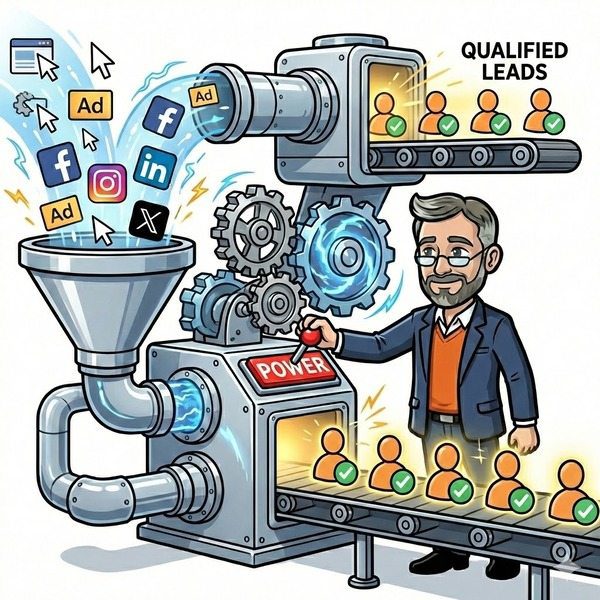
Trade shows remain a highly impactful channel for industrial, manufacturing, and equipment companies in 2027, with major events like CONEXPO-CON/AGG and AGRITECHNICA gathering thousands of decision makers who have budgets, timelines, and problems your equipment can solve. Given the long sales cycles averaging 180 days and a cost per lead near $396 in heavy equipment, every qualified conversation at these events is valuable. However, most trade show leads go unused, often sitting forgotten in spreadsheets or CRMs without context or ownership. Research shows that 80% of trade show leads never get contacted, highlighting a significant gap between investment and actual sales outcomes.
A trade show lead is more than just a booth visitor; it’s a contact from a relevant company who has expressed genuine interest and provided enough information to act on. Effective trade show lead generation is a system that integrates pre-event outreach, on-site engagement, and post-event follow-up. This article covers all stages of that system, including planning, booth execution, lead capture technology, follow-up strategies, hybrid events, measurement, and common pitfalls, drawing on real-world insights from recent major industry events.
Table of Contents
- Trade Show Lead Generation Strategy: Think Pipeline, Not Piles of Badges
- Plan Trade Show Leads Before You Book the Booth
- Design an Effective Trade Show Booth That Captures the Right Leads
- Build a Trade Show Lead Capture System (Not Just a Stack of Business Cards)
- Choosing and Using a Lead Capture App at Trade Shows
- Post-Show Trade Show Lead Follow Up: The First 30 Days
- Hybrid Events, Virtual Touchpoints, and Always-On Lead Generation
- Measuring Trade Show ROI: From Lead Counts to Closed Deals
- Common Trade Show Lead Generation Mistakes to Avoid
- When to Bring in Outside Help for Trade Show Leads
- Why Choose a Specialized B2B Equipment Marketing Partner for Trade Show Leads
- Next Steps: Turn Your Next Trade Show Into a Revenue-Generating Asset
- FAQs About Trade Show Leads and Follow Up
Trade Show Lead Generation Strategy: Think Pipeline, Not Piles of Badges
Trade show lead generation works when you treat it as a pipeline-building system – not a three-day badge-scanning exercise. The system has three stages: before (targeting and outreach), during (qualification and data capture), and after (follow up and conversion). Each stage feeds the next. Skip one and the entire investment underperforms.
The distinction between raw contacts and qualified leads matters enormously. A badge scan tells you someone walked by. A qualified trade show lead tells you a fleet operations director at a mid-size construction firm is evaluating telehandler replacements within 12 months and has budget authority. Among manufacturers, realistic conversion rates show 5–15% of booth contacts become sales-qualified leads, and only 1–4% become pipeline opportunities. Quality over quantity matters when engaging leads during a trade show.
The best teams design their trade show strategy backward from revenue targets and sales capacity. A construction equipment OEM heading to CONEXPO might set a goal of 15 pre-booked meetings with rental fleets, 40 qualified demos, and 80 total scored conversations – not “get 500 badge scans.” Goals for trade show participation should include total badge scans and qualified conversations, but the emphasis belongs on the latter. These targets should align with the B2B buying journey: awareness, evaluation, technical validation, and purchase approval. Your broader lead generation efforts – SEO, outbound, dealer networks, email, paid campaigns – should reinforce the trade show, not operate in a silo.
Additionally, industrial inbound marketing helps attract qualified prospects before and after industry events.
Plan Trade Show Leads Before You Book the Booth
Effective trade show performance is decided months before the exhibit hall opens. Planning should begin six to twelve months out for major events and four to six months for smaller regional shows.
Start by setting specific, numeric goals by segment: target number of qualified conversations with operations managers, number of demos completed, booked site visits, and RFPs initiated. Build an Ideal Customer Profile and target account list by vertical – material handling, mining, waste and recycling, agriculture – and buyer role (operations, maintenance, reliability engineering, finance). Use existing customer data to model likely deal size and timeline.
The U.S. Commercial Service’s trade show guidance recommends measurable goals, trained booth staff, and timely follow-up.
A structured B2B sales funnel also helps teams align event objectives with buyer readiness and sales opportunities.

Show selection matters too. Compare attendee fit, expected deal size, and timing relative to buyers’ capital budgeting cycles. A national event like IMTS offers enormous reach but higher cost; a regional machining expo may deliver a tighter audience at lower investment.
Pre-show marketing starts weeks before the event. A basic campaign plan should include:
- Targeted emails can build buzz before the show and drive booth traffic
- LinkedIn outreach to named accounts and buying-committee contacts
- Phone outreach to priority accounts with calendar links to schedule meetings
- A “Top 50” campaign that captures leads before the event by inviting your most strategic targets to pre-booked meetings
- Social media posts should include your booth number so prospects can find you easily
Offering incentives for pre-booked meetings – exclusive product previews, early access to a demo, or a one-on-one engineering consult – increases attendance significantly. When dealers or distributors are involved, coordinate lead ownership by territory before the show starts to avoid post-event confusion.
Design an Effective Trade Show Booth That Captures the Right Leads
Booth design, messaging, and staff behavior directly shape whether you attract casual visitors or potential customers actively seeking solutions. Your booth has three seconds to grab attention. Booth signage should convey your main value proposition within that window – something concrete like “Cut downtime by 40% in bulk handling systems,” not a vague corporate slogan. Use bold visuals and clear messaging in booth design to stop foot traffic.
A well-designed booth layout invites people in with open sightlines, visible working demos, and enough space for real conversation. Interactive booth elements such as demos or games can attract visitors. Interactive booths increase visitor engagement significantly – whether you use live product demonstrations, VR-based digital twins, or touchscreen configurators. Gamify your booth experience to drive more traffic when appropriate for your audience.
Training booth staff to ask open-ended questions improves lead qualification dramatically. Equip reps with three to four core questions:
- What equipment are you running today?
- Are you looking at replacement, upgrade, or expansion?
- What is your timeline?
- Who else is involved in the decision?
From those answers, staff can apply a simple A/B/C lead score on the spot – A for hot leads with near-term budget authority, B for warm leads in evaluation mode, C for early-stage researchers. Handle scheduled demos and walk-up visitors with separate flows so neither group gets neglected. The best teams script a few key questions and transitions but keep the interaction natural rather than robotic.
Build a Trade Show Lead Capture System (Not Just a Stack of Business Cards)
The era of paper forms, scribbled booth notes on the back of a business card, and untagged badge scans is over. These methods lose context, delay follow up, and make it nearly impossible to segment leads or personalize outreach afterward. Using digital lead capture reduces friction in gathering prospect information and gives your sales teams actionable data the same day.
Standardize what every rep collects for each lead:
| Field | Why It Matters |
|---|---|
| Full name, company, role | Routes lead to the right owner |
| Email, phone | Enables immediate follow up |
| Product interest | Drives personalized content |
| Current equipment/process | Shapes the sales conversation |
| Pain point | Anchors follow up in real context |
| Budget range and timeline | Qualifies urgency |
| Next step promised | Sets expectations for both sides |
Use lead capture apps to record detailed notes instantly during or right after each conversation. Lead capture tools should sync directly to CRM systems for effective management – every lead tagged with event name and date (e.g., “MODEX_2026_Leads”), booth rep, product line, and region. Aim to sync data within hours, not weeks. This structured data capture supports faster handoffs and more relevant follow up email sequences.
Furthermore, proper CRM setup for heavy equipment sales teams improves lead tracking, ownership, and follow-up efficiency.
Choosing and Using a Lead Capture App at Trade Shows
A dedicated lead capture app is essential for any program beyond a handful of conversations. The right tools save time, reduce manual data entry errors, and ensure no lead falls through the cracks.
Capabilities to prioritize in a lead retrieval app or capture app:
- Badge scanning (QR and barcode) plus business card OCR
- Custom qualification fields and quick A/B/C rating
- Free-text note fields for conversation context
- Offline mode (show floor WiFi is notoriously unreliable)
- Direct CRM and marketing automation sync (HubSpot, Salesforce, Dynamics)
Before the show, run mock scans, verify data sync, confirm field mapping, and train booth staff so the tool is second nature.
A practical workflow looks like this:
Scan attendee badges → select product interest (telehandlers, conveyors, compact tractors) → choose intent level → add notes → assign owner. That sequence takes under 30 seconds and captures more useful data than a stack of business cards ever could.
Post-event, deduplicate records across shows, use consistent event naming, and enrich contacts with firmographic data for better lead routing. If you utilize TSL technology or an exhibitor-owned lead retrieval system, you maintain control across multiple events rather than relying on each organizer’s proprietary badge scanners.
Post-Show Trade Show Lead Follow Up: The First 30 Days
This is where most teams fail – and where the biggest ROI gains hide. Speed matters. Leads contacted within 24–48 hours are 60% more likely to convert. Conversely, 80% of trade show leads never receive follow-up contact. Even among those that do, slow follow up past 72 hours causes steep conversion decay.
Follow this timeline:
| Timeframe | Action | Lead Type |
|---|---|---|
| Same day | Acknowledgment email referencing booth conversation | All leads |
| Within 24 hours | Personalized email + phone call | Hot leads (A-rated) |
| Days 2–5 | Follow up email with relevant content, phone call | Warm leads (B-rated) |
| Days 5–10 | Nurture email sequence begins | Early-stage leads (C-rated) |
| Days 10–30 | Multi-touch nurture: case studies, ROI tools, spec sheets | All unconverted leads |
Real-time follow-up improves conversion rates for trade show leads. Initial follow-up messages should reference specific details from conversations – the conveyor line they mentioned, the plant location, the maintenance pain point they described. Clarifying the next steps during follow-up emails increases engagement and keeps momentum alive.
Additionally, the FTC’s CAN-SPAM compliance guide outlines requirements for commercial follow-up emails, including accurate subject lines and opt-out options.
Leads should be segmented based on their engagement level for follow-up. Segment leads by intent to prioritize follow-up efforts: hot leads get direct sales outreach, warm leads get a mix of sales and marketing touches, and early-stage contacts enter automated nurture sequences that can keep leads engaged after the trade show. Consistent multi-touch follow-up is necessary to maintain prospect interest over weeks and months. Personalization enhances follow-up effectiveness after trade shows – a personalized email that references a specific problem discussed will always outperform a generic blast.
Similarly, marketing automation for manufacturing helps teams deliver personalized follow-up messages and nurture prospects throughout lengthy sales cycles.
For industrial buyers, relevant offers include: on-site equipment audits, engineering consults, spec reviews, or sample ROI models. Follow up within 24 hours for better conversion rates on your highest-priority contacts. Even 20–30% of leads convert when followed up within 7–10 days, which is far better than the zero percent return on leads that never hear from you. Coordinate clearly between sales teams and marketing: who handles which segment, how many touches before handoff, and when to move leads into long-term nurture.
Hybrid Events, Virtual Touchpoints, and Always-On Lead Generation
Hybrid events evolved rapidly from 2020 through 2025 and are now standard extensions of major trade shows. Digital showrooms, virtual product launches, and on-demand webinars tied to events like IMTS, MODEX, and CONEXPO allow you to capture leads from buyers who cannot attend in person.
Treat virtual leads with the same rigor as in-person contacts: tag, score, and route them identically. Engagement signals – watch time, content type viewed, questions submitted – inform lead scoring and follow-up priorities. Between shows, on-demand content and virtual tours keep trade show leads warm during long evaluation cycles spanning 12–24 months.
Hybrid events also make it easier to involve distributed buying teams early: engineering reviews a digital demo in one city while finance reviews pricing in another, accelerating consensus before the next in-person touchpoint.
Moreover, effective industrial product marketing connects virtual demonstrations, technical content, and buyer engagement across multiple channels.
Measuring Trade Show ROI: From Lead Counts to Closed Deals
Lead volume alone is a vanity metric. The real measures are sales opportunities created, proposals issued, closed deals, and revenue attributed to each event. Tag all show leads in your CRM to enable reporting by event, product line, territory, and rep.
Core metrics to track:
- Total raw leads vs. qualified leads
- Meetings booked during or before the show
- Quotes and proposals issued
- Closed deals and revenue per event
- Lead-to-opportunity rate and win rate
- Cost per lead, cost per qualified opportunity, and cost per closed deal
- Sales pipeline created and sales cycle length from first conversation to close
Metrics such as lead-to-opportunity rates help measure trade show success far more accurately than badge counts. To prove ROI, calculate total show cost (booth, shipping, travel, staffing, technology) against pipeline and revenue attributed within 12–18 months. One component manufacturer documented 200 scans at a 2024 show, converted 11 into purchase orders over 18 months, generated roughly $400,000 in revenue against $17,000 in show cost – approximately 24× ROI. Capital equipment deals commonly close 6–18 months after the initial trade show conversation, so patience and tracking discipline are essential.
Build a post-event review habit: what worked with booth staff, which pre-show channels booked the best meetings, and which events to repeat or drop for future campaigns.
A revenue-focused approach to measuring marketing ROI helps connect event spending with qualified opportunities and closed deals.
Common Trade Show Lead Generation Mistakes to Avoid
Even experienced exhibitors routinely repeat avoidable mistakes that torpedo trade show ROI.
- Treating every badge scan as equal. Stop treating all contacts the same. Aim for 50 highly qualified leads instead of 500 badge scans. Leads without qualification overwhelm follow-up capacity.
- No clear follow-up owner. Without a single responsible party, leads land in a black hole. Assign ownership before the show.
- Slow data entry and syncing. Delayed CRM entry means delayed outreach. Sync same-day.
- Generic follow-up email blasts. A follow up email that does not reference the conversation or product interest will not engage anyone.
- Untrained booth staff. Reps focused on scanning volume instead of having a real conversation produce low-value data.
- Failing to log installed-base details. Equipment companies that skip serial numbers, fleet sizes, or current machine models lose critical context for follow up.
- Ignoring dealer territory alignment. When the same leads get contacted by both OEM reps and dealers without coordination, trust erodes.
Fixing follow up and data issues often yields better ROI than spending more on bigger booths or flashier displays.
Additionally, co-op advertising helps manufacturers and dealers coordinate promotional efforts while maintaining consistent messaging.
When to Bring in Outside Help for Trade Show Leads
When internal sales and marketing teams are stretched thin – running four to six shows per year while managing day-to-day pipeline – a specialized partner can fill critical gaps.
Look for a partner who understands B2B equipment sales, complex buying committees, long sales cycles, and the nuance of dealer networks. Practical services include pre-show appointment setting, booth staff playbooks, on-site lead capture setup, CRM workflow configuration, and post-show nurture campaigns. Collaboration should involve clear handoffs, shared KPIs, and transparent reporting on lead quality and revenue impact. The right partner works with your existing team and dealers – not around them.
Why Choose a Specialized B2B Equipment Marketing Partner for Trade Show Leads
Industrial and equipment buying cycles involve technical specs, safety requirements, multi-level approvals, and timelines that generic marketing agencies simply do not understand. Pro Equipment Marketing specializes in exactly this world – construction equipment, agricultural machinery, warehouse automation, food processing systems, material handling, mining, and waste and recycling.
What sets the right partner apart for trade show success is the ability to connect lead capture and follow up directly to pipeline dashboards and revenue numbers executives care about. That means CRM and marketing automation implementation tuned for equipment sales, outbound appointment setting with the right messaging, content strategy built around real buyer questions, and conversion optimization around events. The goal is not to replace your sales team or dealers but to build an effective trade show system that makes every event measurably more productive and maximizes brand visibility across the shows that matter most.
Next Steps: Turn Your Next Trade Show Into a Revenue-Generating Asset
Trade show leads become profitable only when smart planning, disciplined lead capture, fast follow up, and clear measurement work together. No single tactic – not a bigger booth, not a flashier display, not a new app – fixes the system alone.
Start by auditing your last two or three trade shows. Look at lead quality, follow-up timing, and actual deals closed. Identify the biggest gap. Then outline a basic “before, during, after” plan for your next trade show using the sections above as a checklist. Whether you are heading to CONEXPO 2027, PACK EXPO, or a regional equipment expo, the process is the same.
If you want help building a repeatable trade show lead system that connects to real pipeline and revenue, reach out to the Pro Equipment Marketing team. Schedule a consultation or request a trade show lead process review before your next big event – so the leads you collect actually turn into closed deals.
FAQs About Trade Show Leads and Follow Up
How many trade show leads should we aim for at a major event?
Target numbers depend on booth size, staff count, event traffic, and average deal size. A 20×20 booth at CONEXPO with four to six booth staff should aim for 60–100 qualified conversations rather than hundreds of shallow scans. Set separate goals for hot leads (near-term buyers), warm leads (evaluating over 6–12 months), and strategic contacts (partners, media, dealers). For most equipment companies producing successful conventions attendance, 10–20 hot leads per major event drive the majority of resulting pipeline and closed deals.
What information should we collect to make follow up effective?
Capture full contact info, company, role, current equipment or process, stated pain point, budget range, timeframe, decision process, and the agreed next step. Each data point helps tailor follow up – referencing a specific conveyor line or plant location in your follow up email turns a generic touchpoint into a relevant one. Keep core fields mandatory but brief; add free-text booth notes for detail without slowing down the conversation.
How fast should we follow up on trade show leads?
Same-day acknowledgment is the baseline. Within 24 hours for priority leads is the standard for an effective trade show team. Leads contacted promptly are dramatically more likely to convert. A realistic plan for companies returning from large events: triage on the flight home, first wave of emails day one, calls days two through five. Speed matters more than polish in the first outreach.
How do we handle trade show leads that are early-stage or “just looking”?
Segment these into nurture tracks instead of ignoring them or forcing a premature demo. Useful content includes application notes, comparison guides, maintenance checklists, and ROI calculators relevant to their future budget cycles. Set reminders around known project dates – fiscal year budgets, planned plant shutdowns, fleet replacement windows – for later follow up during educational sessions or via drip campaigns.
What’s the best way to coordinate leads between our reps and dealers?
Establish clear lead-routing rules before the show: geography, verticals, key accounts, and house accounts. Use a centralized CRM with consistent tagging so both OEM reps and dealers can manage leads and track follow-up and pipeline without stepping on each other. Dealers should update lead status so the OEM maintains visibility into what portion of the sales pipeline is advancing.
Can hybrid events really generate high-quality equipment leads?
Yes – when positioned as part of a broader campaign rather than one-off webinars. Virtual plant tours, digital launch events timed around major shows, and on-demand demo libraries with clear calls to action all generate high intent leads. Hybrid engagement signals like watch time and questions asked feed lead scoring and help sales teams prioritize follow-up. These touchpoints also support tracking engagement across the full buyer journey.