
This article focuses on practical B2B strategies for the agricultural machinery market and farm equipment dealers. It covers global agricultural machinery market trends, digital and traditional channels, and revenue-focused tactics that connect marketing spend to equipment sales.
Table of Contents
Introduction: Why Agricultural Machinery Marketing Matters in 2026
Understanding the Agricultural Machinery Market and Buyer Landscape
Global Agricultural Machinery Market Trends You Must Market Around
Regional Nuances: Marketing Agricultural Machinery in North America, Europe, and Asia Pacific
From Features to ROI: Positioning Farm Equipment for Value, Not Just Specs
Balancing Traditional and Digital Channels in Agricultural Machinery Marketing
Local SEO and Dealer Visibility for Farm Equipment Buyers
Website and Conversion Strategy for Agricultural Machinery Companies
SEO Strategy: How Agricultural Machinery Buyers Actually Search
PPC for Fast, High-Intent Agricultural Machinery Leads
Content Marketing: Educating Farmers Through the Long Buying Cycle
Video and Demonstration Strategy for Farm Machinery
Email Marketing and Lead Nurturing in Long Sales Cycles
Social Media and Community Building with Modern Farmers
Dealer and Distribution Network Marketing Support
Financing, Leasing, and Overcoming High Upfront Costs
Data, Analytics, and CRM: Connecting Marketing to Equipment Sales
Aftermarket, Parts, and Service Marketing
Common Mistakes in Agricultural Machinery Marketing (and How to Avoid Them)
When to Rethink Your Agricultural Machinery Marketing Strategy
Why Choose a Specialized Equipment Marketing Partner
Next Steps: Building a Revenue-Focused Agricultural Machinery Marketing Plan
FAQs About Agricultural Machinery Marketing
Introduction: Why Agricultural Machinery Marketing Matters in 2026
The global agricultural machinery market was valued at USD 171.80 billion in 2024. By 2031, projections place the agricultural machinery market at USD 267 billion. Between those two numbers sits a period of rapid change: farm labor shortages across the U.S. and Europe, precision farming technologies reshaping buyer expectations, and post-pandemic supply chain disruptions that rewired how equipment manufacturers plan inventory and go-to-market.
Yet 2026 has brought its own pressure. Sales of agricultural tractors in the U.S. dropped 9.1% in 2026. Combine sales fell 25.3% in the U.S. compared to 2025. Equipment manufacturers, dealers, and distributors that still rely mostly on referrals, trade shows, and personal relationships to fill their pipeline are watching qualified leads shrink while the competitive landscape tightens.
Effective agricultural machinery marketing combines trust-building, field demonstrations, dealer relationships, and digital strategies into a single system that generates revenue. This article is a step-by-step, revenue-focused playbook for marketing tractors, harvesting machinery, planting equipment, and other farm machinery to the people who actually buy it. No theory for theory’s sake; every section ties back to pipeline, leads, and closed deals.
Understanding the Agricultural Machinery Market and Buyer Landscape
The agricultural machinery industry breaks into several equipment segments, each with different buyer motivations and sales cycles.
Tractors remain the anchor. Tractors accounted for 35.9% of the agricultural machinery market in 2025, spanning everything from 31-70 HP mid range tractors used on smallholder farms in India to 130+ HP high horsepower tractors running GPS-guided tillage across the U.S. Corn Belt. The harvesting machinery segment is projected to grow at a CAGR of 6.0% from 2026 to 2031, driven by demand for combine harvesters, self propelled sprayers, and specialized machinery for crops like canola, rice, and sugarcane. Other segments include planting machinery and planting equipment, irrigation equipment and irrigation systems, land preparation implements, spraying rigs, and post-harvest processing.
The agricultural machinery value chain starts with raw material suppliers. Major global steel producers supply raw materials for machinery frames, axles, and housings. OEMs design and assemble tractors and harvesters from components, building each complete machine to specification. Dealers provide financing options and after-sales support to customers. Aftermarket services include maintenance and spare parts supply. Feedback from end-users informs design improvements for OEMs, creating a loop that shapes the next generation of advanced machinery.
Buyer types vary widely:
| Buyer Type | Key Priorities | Typical Equipment |
|---|---|---|
| Owner-operators / smallholders | Low capital cost, financing, fuel economy | Mid range tractors, compact harvesters |
| Large commercial farms | Throughput, uptime, precision integration | High horsepower tractors, combine harvesters, self propelled sprayers |
| Custom operators / contractors | Durability, service support, fleet flexibility | Harvesting equipment, planting machinery, sprayers |
| Rental fleets | Utilization rates, maintenance predictability | Mixed fleets across categories |
| Government / co-ops | Compliance, subsidies, bulk procurement | Varies by program |
Farmers buy agricultural machinery based on ROI, durability, and trusted relationships. Trust in local dealers and access to reliable service affect purchasing decisions more than glossy brochures. This holds true whether a buyer is financing a USD 400,000 combine in Nebraska or a USD 12,000 utility tractor in Maharashtra.
Asia-Pacific held 36.8% of the agricultural machinery market in 2025, making it the largest regional market by share. North America and Europe follow, each with distinct buying behaviors shaped by farm size, regulation, and the local competitive landscape among key companies like John Deere, CNH Industrial, AGCO Corporation, Kubota Corporation, and Argo Tractors.
Global Agricultural Machinery Market Trends You Must Market Around
Three macro forces are reshaping what buyers expect and how they evaluate farm equipment.
Farm labor costs and shortages. The average gross wage for hired farm workers was USD 19.10 per hour in October 2024. In some regions, field workers earned between USD 15.25 and USD 19.15 per hour depending on state and task. Those labor costs compound across thousands of acres. Farm labor shortages are influencing purchasing decisions in the machinery market; farmers who cannot hire enough seasonal workers are turning to autonomous tractors, auto-steer systems, and precision agriculture solutions that reduce labor dependency. The number of farms in the U.S. decreased to 1.86 million in 2025, meaning fewer, larger operations shoulder rising input costs with thinner margins.
Technology integration. Precision agriculture technologies improve yield efficiency and reduce labor dependency. AI and automation are transforming agricultural machinery operations, from sensor-based planting to variable-rate fertilizer application to autonomous field navigation. The autonomous tractors market was valued at roughly USD 3 billion in 2025, with forecasts pointing toward USD 14-16 billion by the early 2030s. Automatic systems in agricultural machinery are projected to grow at 6.2% CAGR. Precision technology has become essential in agricultural equipment marketing because buyers now expect GPS guidance, telematics, and data analytics as standard features on advanced agricultural machinery, not optional add-ons.
Sustainability pressure. Sustainable farming and sustainable agriculture mandates are tightening in Europe (Stage V emissions, EU Green Deal), California, and parts of Asia Pacific. Marketing messages around fuel efficiency, lower carbon footprint, reduced soil compaction, and precision farming that cuts chemical inputs resonate with both regulatory requirements and farmer values. Smart farming solutions and precision agriculture solutions are no longer niche; they’re central to how equipment manufacturers position new equipment.
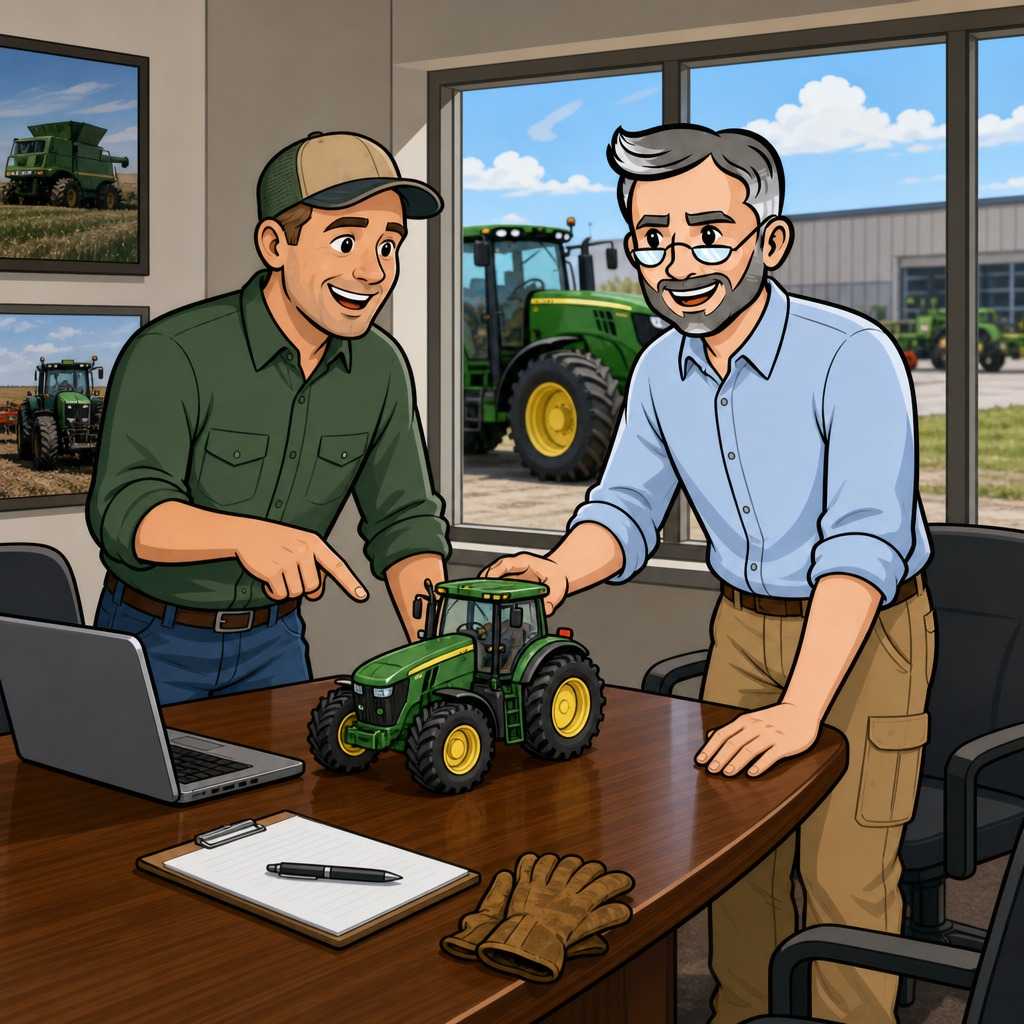
The takeaway for marketing teams: these trends should shape your content calendar, ad copy, sales collateral, and product positioning. A tractor landing page that lists only horsepower, PTO speed, and lift capacity misses the buyer who wants to know how many operator hours per season the machine eliminates.
Regional Nuances: Marketing Agricultural Machinery in North America, Europe, and Asia Pacific
North America experienced elevated equipment purchases during 2021-2022, fueled by stimulus spending and high commodity prices. The correction arrived in 2025-2026 with tractor sales and combine sales both declining. North America is projected to grow at a 7.2% CAGR from 2026 to 2031, but in the near term, used equipment programs, trade-in incentives, and financing flexibility will drive more conversations than new equipment launches alone. Marketing content here should address the ROI of upgrading existing equipment versus absorbing another year of repair costs. High horsepower tractors and large combine harvesters remain the core products, but the value story matters more now than during peak commodity years.
Europe centers on sustainability, compliance, and subsidy-driven adoption. Government subsidies under the Common Agricultural Policy and national mechanization programs often require demonstration of environmental benefits. If your marketing collateral does not quantify fuel savings, emissions reduction, or soil health improvement, your equipment may not even qualify for the subsidy programs that fund the purchase. Specialized machinery for vineyards, orchards, and mixed-crop operations is a meaningful share of the European market. Messaging around modern farming practices, data-driven input management, and electric or hybrid powertrains resonates with European buyers who face both policy requirements and consumer pressure on sustainable farming.
Asia Pacific is the volume engine. India alone moved roughly 1.19 million tractors (including exports) in 2025. Buyers in India, China, and Southeast Asia are more price-sensitive and rely on government subsidies, credit structures, and dealer financing to purchase equipment. Domestic manufacturers compete alongside global OEMs on cost and local service coverage. Marketing in this region demands regional language content, hyperlocal targeting, and strong dealer-level support. Farm mechanization is still in early stages for many smallholders, so the message shifts from “upgrade” to “mechanize for the first time.”
A brief note on other regions: the Middle East, Latin America, and Africa represent pockets of market expansion for specific equipment categories. Latin America’s large scale farming operations (especially in Brazil and Argentina) align more closely with North American buying behavior, while parts of Africa mirror the first-time mechanization patterns seen in Asia Pacific.
From Features to ROI: Positioning Farm Equipment for Value, Not Just Specs
Buyers scrutinize ROI and total cost of ownership during machinery purchasing. A spec sheet that reads “RTK-GNSS, 2.5 cm pass-to-pass accuracy” means nothing to a farm manager unless it translates to “reduces overlap by 5-8%, saving 300-500 gallons of diesel per season on a 2,000-acre operation.” ROI-oriented marketing is crucial as farmers are cautious about machinery investments.
Here is how to reframe common features:
| Technical Feature | ROI Translation |
|---|---|
| Auto-steer / GPS guidance | Reduces overlap, cuts fuel and input waste per acre |
| Variable-rate application (ISOBUS) | Lowers fertilizer/chemical spend by applying only what each zone needs |
| Telematics / remote monitoring | Cuts unplanned downtime; enables predictive maintenance scheduling |
| Section control on sprayers | Eliminates double-application on headlands and point rows |
| High-capacity grain tank | Fewer unloading stops per field, more acres harvested per hour |
Case studies, before-and-after comparisons, and ROI calculators are important in marketing. One 2025 campaign by Fendt (“Harvesting Tomorrow”) spent USD 1.5 million and generated 4.8x ROAS, with a cost per qualified lead of USD 125 and a 12% conversion rate from qualified lead to sale. The campaign’s success came from featuring real-farmer stories focused on pain points like labor shortages, not from listing engine specifications.
Connected machinery facilitates ongoing customer engagement and service opportunities. Telematics integration is standard on mid-range agricultural equipment and above, meaning your marketing can highlight ongoing value (uptime alerts, usage optimization, warranty tracking) rather than treating the sale as a one-time event.
Build ROI calculators into your product landing pages. Let the prospect enter their acreage, fuel cost, and local wage rate, then show estimated annual savings and payback period. This turns a passive product page into an interactive sales tool.
Balancing Traditional and Digital Channels in Agricultural Machinery Marketing
B2B agricultural machinery marketing requires both traditional and digital strategies. Neither channel alone covers the full buying journey.
Long sales cycles can last months or years. A farmer considering a new combine may start researching 18 months before placing an order. During that window, they visit a trade show booth, watch YouTube walkarounds, read a comparison article, attend a dealer open house, and talk to three neighbors who own competing brands. Integrated marketing strategies reflect the entire customer lifecycle from awareness to ownership.
Traditional channels still matter. Demonstration days and field trials help prove machinery performance in ways that no video or brochure can replicate. Customer testimonials and peer referrals are critical in agricultural machinery marketing; a farmer’s neighbor carries more weight than a display ad. Trade shows like Agritechnica, Farm Progress Show, and national FFA conventions remain high-value touchpoints.
Digital channels accelerate and extend reach. Farmers use a mix of digital channels and personal interactions for equipment purchases. A campaign by Agrosul John Deere in Brazil combined digital traffic management with data targeting and delivered a ROAS of 11,667% over 50 days. In India, Pahel Agrotech ran full-funnel Meta and Google campaigns with regional language video creatives and generated 4,272 leads in a single month at a cost per lead under USD 1 for certain formats.
Marketing strategies must align with the agricultural calendar, which affects purchase timing. Planting equipment campaigns peak before spring; harvesting machinery campaigns need to land in late summer. Long sales cycles in agricultural machinery require consistent follow-up and engagement across both channels, not a burst of activity followed by silence.
The practical approach: coordinate a new product launch with a major industry event, then run a digital campaign for three to six months before and after the event. Use the event for in-person demos and relationship-building; use digital to capture the research-phase traffic that the event alone cannot reach.
Local SEO and Dealer Visibility for Farm Equipment Buyers
When a buyer searches “used 200 HP tractor near me” or “corn header repair Iowa,” they are past the research phase and ready to act. Digital marketing in agriculture focuses on local SEO and Google Business Profiles because these searches carry the highest purchase intent.
Every farm equipment dealership location needs:
- A dedicated landing page optimized for the dealership’s city, county, and service area
- Inventory pages with clear model names, HP ratings, and pricing (or “call for price” with a click-to-call button)
- An accurate Google Business Profile with current hours, service offerings, lot photos, and regular posts featuring specific models or promotions
- Consistent name, address, and phone (NAP) data across all directories
A dealer in a mid-sized agricultural region who updates their Google Business Profile weekly with inventory photos and seasonal service promotions will outperform a competitor with an outdated listing and no reviews. The fix is not complicated, but it requires consistency. Most farm equipment dealers underinvest here because it feels less urgent than a trade show. The data says otherwise: local search queries for ag equipment convert at rates well above generic brand searches.
Website and Conversion Strategy for Agricultural Machinery Companies
Farmers spend more time evaluating options online before contacting dealers. Farmers are increasingly mobile-reliant, using smartphones for agricultural research from the field, the cab, or the kitchen table. If your website loads slowly on a mobile connection or buries the “Request a Quote” button behind three navigation layers, you lose that prospect to a competitor whose site works.
A modern equipment website must:
- Show inventory with filters by category (tractors, harvesting machinery, sprayers, irrigation machinery, other farm machinery), HP range, and condition (new vs. used)
- Explain technology with application pages that match equipment to farm type (row crops, dairy, orchards, vineyards)
- Capture leads through simple quote request forms, “schedule a demo” CTAs, financing pre-qualification forms, and prominent phone numbers
- Support dealer networks with a dealer locator, co-branded pages, and lead routing that sends inquiries to the correct dealership
Core pages for any agricultural machinery company website:
- Equipment category pages (tractors, harvesting equipment, planting equipment, sprayers, irrigation equipment)
- Application/use-case pages (corn and soybean, dairy and livestock, specialty crops)
- Used and certified pre-owned equipment listings
- Parts and service pages with online ordering or inquiry forms
- Financing and leasing information with example payment scenarios
- About and trust pages (history, certifications, dealer network map)
Every page should load in under three seconds and render cleanly on a 5-inch screen.
SEO Strategy: How Agricultural Machinery Buyers Actually Search
SEO is critical for attracting high-intent buyers in agriculture. But not all search queries signal the same intent.
Informational queries like “agricultural machinery market trends 2026” or “precision farming technologies comparison” indicate a buyer in early research. These queries feed your blog and resource center. Educational content and value-driven messaging help capture buyer interest at this stage.
Purchase-intent queries like “2025 8R tractor price Ohio” or “used Lexion combine financing” signal a buyer ready to talk to a dealer. These queries need product pages, inventory listings, and dealer-specific landing pages.

Build content silos around equipment categories:
- Farm equipment for tillage and land preparation
- Planting machinery and seeding technology
- Crop care: spraying, irrigation systems, self propelled sprayers
- Harvesting equipment and combine harvesters
- Parts, service, and aftermarket
Integrate brand-agnostic keywords (“200 HP row crop tractor”) alongside common brand terms. When a farmer searches “Kubota Corporation compact tractor vs. John Deere 3E,” they want a comparison. If your site provides that comparison honestly, you earn the click and the trust. Use long-tail, geo-modified phrases like “used 31-70 HP tractor financing in Texas” to attract regional buyers with strong purchase intent.
Avoid thin pages. A single “tractors” page without HP ranges, crop applications, or regional context will not rank against a competitor who builds out twenty pages covering mid range tractors, high horsepower tractors, compact utility models, and each with specific use cases.
PPC for Fast, High-Intent Agricultural Machinery Leads
PPC is built for markets where a single deal can justify months of ad spend. A new combine harvester sale might generate USD 300,000-500,000 in revenue. Even at a cost per qualified lead of USD 100-200, the economics work.
High upfront costs deter farmers from purchasing new equipment, so your ad copy needs to address that objection directly. Ads that lead with “0% financing for 36 months” or “trade-in your current combine” outperform ads that simply list model numbers.
Structure campaigns by intent:
- Brand/model searches: Capture buyers searching for specific equipment by name (e.g., “AGCO Corporation Fendt 1100 Vario”)
- Generic equipment searches: Target buyers comparing categories (e.g., “best combine for corn and soybeans 2026”)
- Problem-solution searches: Reach farmers looking to solve operational problems (e.g., “reduce harvest labor cost,” “improve planting accuracy”)
Track every form submission, phone call, and inventory inquiry back to the campaign and keyword that generated it. Without this tracking, you cannot calculate true cost per qualified lead, and you will overspend on keywords that generate clicks but not revenue.
Content Marketing: Educating Farmers Through the Long Buying Cycle
Farmers begin researching months before they contact a dealer. The content you publish during that window determines whether your brand is on their shortlist.
Effective content types for the agricultural machinery industry:
- Seasonal maintenance checklists: “Pre-harvest combine inspection: 12 points to check before you cut the first row”
- Side-by-side machinery comparisons: “2WD vs. 4WD tractor for 200-acre mixed farms: cost, traction, and resale”
- HP selection guides: “How to choose tractor horsepower for your operation size and terrain”
- Financing explainers: “What a USD 300,000 combine looks like at current interest rates and grain prices”
- Case studies from real farms: Data on fuel savings, uptime improvements, and payback periods
AI-driven content enhances agricultural machinery marketing effectiveness when used to scale production of search-optimized articles. But the content must still reflect genuine expertise. A generic article about “farm productivity” that could apply to any decade will not compete with a piece that references current tractor sales trends, specific equipment models, and real cost data.
Feature case studies from different regions and crop types. A corn farmer in Iowa has different questions than a sugarcane producer in Queensland or a rice grower in Punjab. The more specific your content, the more qualified the leads it attracts.
Video and Demonstration Strategy for Farm Machinery
Video marketing effectively demonstrates agricultural machinery capabilities in ways that text and photos cannot. Buyers want to see machines running in real field conditions: soil type, crop height, dust, speed, turning radius, cab noise level.
Practical video formats:
- Walkaround tours of new model tractors and harvesters, showing controls, cab layout, and maintenance access points
- In-field demos of harvesting machinery cutting through standing corn at operating speed, with data overlays showing yield monitor readings
- Side-by-side comparisons of attachments or configurations (e.g., 8-row vs. 12-row corn head throughput)
- Operator and service tech interviews discussing real-world uptime, common issues, and tips
Publish consistently on YouTube and embed videos on product pages. Short clips (60-90 seconds) work well for social media campaigns and email. Longer formats (5-15 minutes) serve buyers deeper in the research phase.
Feature real operators, not actors. Farmers trust people who look and talk like them, standing in muddy boots next to a machine that has been running all week.
Email Marketing and Lead Nurturing in Long Sales Cycles
A prospect who requests a quote on a harvesting platform in March may not purchase until the following January. Email keeps your brand in front of that buyer through the entire decision window.
Segment lists by:
- Crop type (row crops, specialty, livestock)
- Acreage or operation size
- Region and climate zone
- Equipment interest (planting vs. harvesting vs. tractors)
Effective email themes:
- Pre-season inspection reminders (“Book your combine service before the June rush”)
- Model closeout and end-of-year deals
- Technology upgrade campaigns (“Add auto-steer to your existing equipment for USD X”)
- Post-demo follow-ups with personalized ROI estimates
- New inventory alerts matching the buyer’s stated preferences
Track replies, clicks, and conversion to booked appointments inside a CRM. Open rates tell you who is reading; click-through rates tell you who is interested; booked demos tell you who is ready to buy. Do not optimize email strategy around open rates alone.
Social Media and Community Building with Modern Farmers
Facebook remains the dominant social platform for farmers in North America and many parts of Europe. YouTube is the second most important channel for equipment research. Instagram and LinkedIn serve narrower purposes: Instagram for brand storytelling and recruitment; LinkedIn for B2B relationships with fleet managers, co-op buyers, and industry experts.
Content should be practical and local:
- Used inventory spotlights with pricing and dealer location
- Real-farm demo clips from the current season
- Customer stories with before-and-after data
- Service tips and quick maintenance walkthroughs
Join farming groups and contribute useful advice. A post answering “What oil weight do you run in your 200 HP tractor in sub-zero temps?” builds more credibility than a paid ad for the same tractor.
Paid social campaigns work best for promotions, dealer events, and new model launches. Geo-target campaigns tightly around dealer territories so ad spend goes to buyers who can actually visit the dealership.

Dealer and Distribution Network Marketing Support
The agricultural machinery industry runs through dealers. An OEM can build the best combine in the world, but if the local dealer cannot generate leads, follow up on inquiries, or communicate the value proposition, that machine sits on the lot.
Co-op marketing programs and market development funds (MDF) enable OEMs and dealers to share campaign costs. Co-branded campaigns for tractors and harvesting machinery let OEMs maintain brand consistency while dealers customize for local crop types, terrain, and buying seasons.
What works:
- Centralized content and campaign templates OEMs push to dealers, with editable fields for local inventory, pricing, and dealer branding
- Localized visuals that reflect the region’s crops and farming practices (cotton in Texas looks different from canola in Saskatchewan)
- Training workshops for dealer sales and marketing staff on lead management, CRM usage, and digital follow-up
A CLAAS campaign in North America combined PR, social, influencer content, and dealer content syndication to deliver an ad equivalency ROI of roughly 1,300%. The key was not choosing between national brand campaigns and local dealer activity; it was running both in coordination.
Financing, Leasing, and Overcoming High Upfront Costs
Financing options are crucial for overcoming high equipment costs. A 400 HP tractor with full precision integration can exceed USD 500,000. A large combine with headers and options runs USD 400,000-700,000. Most farms cannot write a check for that.
Financing options are crucial for high-cost machinery purchases, and they should be visible in every piece of marketing collateral, not buried in a footnote.
Marketing should feature:
- Low-rate financing programs with monthly payment examples
- Seasonal payment schedules aligned with harvest revenue
- Customized leasing options and financing plans that can close deals with hesitant buyers
- Trade-in programs that reduce out-of-pocket cost for advanced equipment
- Government programs that offer low-interest loans for equipment purchases
- Subsidies that reduce barriers to mechanization for farmers, especially in emerging markets
Farm machinery banks provide access to equipment without ownership, a model gaining traction in India and parts of Africa where smallholders need mechanized services but cannot purchase equipment individually. Credit structures support farmers in acquiring advanced machinery in both developed and developing markets.
Marketing should reframe the price conversation. Instead of defending a high sticker price, show what the equipment costs per acre per year, and compare that to the cost of running aging existing equipment with escalating repair bills. Example messaging: “Your current combine costs you USD 18/acre in repairs and downtime. This new model runs at USD 11/acre including financing. That is USD 7/acre back in your pocket across 3,000 acres.”
Data, Analytics, and CRM: Connecting Marketing to Equipment Sales
Every OEM and farm equipment dealership should connect marketing activity to a CRM that tracks quotes, demos, trade-ins, and closed deals. Without this connection, you cannot answer the question that matters: “Which marketing dollars produced equipment sales?”
Key metrics to track:
| Metric | Why It Matters |
|---|---|
| Cost per qualified lead | Tells you what it actually costs to produce a buyer who is real and ready |
| Demo-set rate | Measures how well your follow-up converts inquiries to in-person engagement |
| Quote-to-sale conversion | Shows how effectively your sales process closes interested buyers |
| Lead close time | Reveals whether your nurturing is accelerating or stalling decisions |
| Revenue by channel | Identifies which channels (SEO, PPC, events, referrals) produce actual deals |
Maintain separate pipelines for new equipment, used machinery, rentals/fleet, and aftermarket parts and service. These are different profit pools with different margins, different buyer motivations, and different sales cycles. Lumping them together obscures where your marketing is working.
Decisions about ad spend and content priorities must come from real data. One Australian agricultural marketing firm, Harvest Lead, found that the cheapest lead sources often did not produce sales. The leads that cost more per acquisition but came from higher-intent channels drove the actual revenue.
Aftermarket, Parts, and Service Marketing

Parts and service often carry margins of 30-40%, making them a critical profit center in the agricultural machinery industry. Yet most equipment companies spend the vast majority of their marketing budget on selling equipment, with almost nothing allocated to aftermarket revenue.
Tactics that drive aftermarket revenue:
- Pre-season inspection campaigns: Email and social campaigns in February-March (Northern Hemisphere) reminding farmers to book combine and planter service before the rush
- Extended warranty programs: Marketed at point of sale and again at warranty expiration
- Parts ordering pages: Dedicated landing pages with part number search, VIN/serial lookup, and clear shipping and availability information
- Emergency repair messaging during harvest: “24-hour parts hotline” campaigns that run during peak harvest weeks
- Loyalty programs for multi-unit customers and fleet operators
Predictive maintenance is the frontier. Connected machinery with telematics can alert dealers when a component is approaching failure, triggering a proactive service outreach. This turns reactive repair into scheduled maintenance, which increases uptime for the farmer and recurring revenue for the dealer. Marketing these capabilities to buyers at the point of sale adds perceived value to the equipment and differentiates your brand from competitors who sell the machine and wait for something to break.
Common Mistakes in Agricultural Machinery Marketing (and How to Avoid Them)
Mistake 1: Feature-first product pages. Publishing a “tractors” page that lists engine displacement, PTO speed, and hydraulic flow without specifying HP ranges, crop applications, or region-relevant use cases. Fix: build segmented pages for each product line with ROI context, not just specs.
Mistake 2: Ignoring used equipment content. Many dealers treat used inventory as an afterthought on their website, with a single page of thumbnail photos and no descriptions. In a market where elevated interest rates push buyers toward used equipment, this is leaving revenue on the table. Fix: give every used machine its own page with photos, hours, condition notes, and a financing estimate.
Mistake 3: Neglecting local SEO. A farm equipment dealership with three locations but one generic website and no Google Business Profile optimization will lose local search traffic to a smaller competitor who keeps their listings current. Fix: dedicate one hour per week to updating each location’s profile.
Mistake 4: Failing to follow up leads. Market research consistently shows that speed to response correlates with close rates in high-value B2B sales. A web inquiry about a combine that sits in an inbox for five days will go to the dealer who called back in two hours. Fix: set up CRM alerts that notify the right salesperson within minutes.
Mistake 5: Unmeasured trade show spend. A booth at a major ag show can cost USD 50,000-150,000 when you add travel, setup, and staff. Without tracking which leads came from the show and whether they converted, you cannot compare that investment to a PPC campaign that costs USD 10,000/month and generates measurable leads. Fix: scan badges, collect contact info, load into CRM, and track pipeline from event source.
When to Rethink Your Agricultural Machinery Marketing Strategy
Warning signs that your current approach is underperforming:
- Website leads are flat or declining while regional equipment sales (per industry association data) are growing
- Close rates from digital inquiries are below 5%, suggesting low lead quality or poor follow-up
- More than 60% of new business comes from a single salesperson’s personal network
- Your used equipment sits on the lot 30+ days longer than competitors in the same region
- Dealer partners report that OEM marketing materials do not match local crops, seasons, or buyer profiles
Review strategy at least once per year. Conduct a deeper audit whenever a major product line launches (e.g., a new harvesting platform or autonomous tractor line). External triggers also warrant review: shifts in government agencies’ subsidy programs, new emissions regulations, or a competitor launching a subscription or autonomous-as-a-service model.
Industry trends in the agricultural machinery market move on multi-year cycles. The companies that update their marketing between cycles, not after the next downturn, capture disproportionate market share during the recovery.
Why Choose a Specialized Equipment Marketing Partner
Agricultural machinery marketing is not generic B2B marketing. The sales cycles run longer. The deal values run higher. The buyer personas require understanding of crop calendars, farm finance, and dealer network dynamics. A marketing partner who has only worked with SaaS companies or retail brands will struggle to produce content, campaigns, and lead management processes that connect to actual equipment sales.
Pro Equipment Marketing specializes in equipment manufacturers, OEMs, dealers, distributors, and rental/fleet providers. Our services and capabilities include industrial SEO, paid media for high-value equipment, CRM integration, outbound prospecting, and content built for technical buyers like farm managers and agronomists. The focus is on outcomes: more qualified farm equipment leads, stronger dealer support, and more predictable revenue. Not vanity metrics. Not vague brand awareness. Pipeline and revenue.
Experience across the agricultural machinery industry, construction equipment, material handling, and other heavy machinery categories means the team understands how to market a complete machine with a six-figure price tag and a twelve-month sales cycle. That experience translates directly into faster time-to-results and fewer wasted dollars.
Next Steps: Building a Revenue-Focused Agricultural Machinery Marketing Plan
The agricultural machinery market rewards companies that build marketing infrastructure between cycles, not after the downturn has already compressed margins. The forecast period through 2031 points to continued market growth driven by farm mechanization, precision farming technologies, autonomous tractors, and rising demand for advanced equipment in Asia Pacific and other expanding regions.
Start with this checklist:
- Audit your current website and local SEO presence for every dealership location
- Set up or improve CRM tracking so every lead, demo, quote, and closed deal is attributed to a source
- Pilot one PPC campaign targeting high-intent buyers for your strongest product line
- Plan three to six months of educational content aligned with your buyers’ research questions and the agricultural calendar
- Review your used equipment and aftermarket marketing; ensure it receives dedicated pages, email campaigns, and ad spend proportional to its revenue contribution
- Evaluate your dealer support programs to confirm co-op funds, content templates, and training are reaching the locations that need them
The market value of the global agricultural machinery market will continue to climb. Equipment manufacturers and dealers who connect their marketing spend to measurable pipeline and revenue will capture share. Those who wait for the next cycle will spend more to catch up.
If you sell farm equipment, agricultural machinery, harvesting equipment, or ag equipment, and you want marketing that produces qualified leads and closed deals, request a consultation. We will audit your current marketing, identify the highest-ROI opportunities, and build a plan that connects every dollar to your equipment sales pipeline. Reach out to Pro Equipment Marketing to start the conversation.
FAQs About Agricultural Machinery Marketing
How long does it take to see results from agricultural machinery marketing?
PPC and paid social campaigns can generate farm equipment leads within weeks of launch. SEO and content marketing typically take 6-12 months to produce measurable pipeline impact, depending on competitive intensity and domain authority. The full sales cycle for major machinery (tractors, combines, harvesting equipment) can run 6-24 months from first inquiry to closed deal, so marketing measurement should track influenced revenue over time, not just immediate conversions. A PPC campaign launched in January to promote a new 200+ HP tractor may not show a closed sale until fall, but it should show demo bookings and quote requests within 60-90 days.
Do digital channels really work for big-ticket farm machinery?
Yes. Farmers spend more time evaluating options online before contacting dealers, and many high-value deals in 2024-2026 started with online search or social discovery before moving to phone calls, demos, and on-farm visits. A John Deere dealer campaign in Brazil generated 11,667% ROAS through digital channels alone over a 50-day period. An Indian ag equipment company produced 4,272 leads in one month via Meta and Google campaigns. Digital does not replace the handshake and the field demo; it generates the initial contact that makes the handshake possible.
How should we budget for agricultural machinery marketing?
Think in terms of cost per acquired customer and percentage of target equipment revenue rather than a fixed monthly ad spend number. If your average tractor deal generates USD 150,000 in revenue and your acceptable cost per acquisition is 2-3%, that gives you a USD 3,000-4,500 budget per customer acquired. Start with a test-and-scale approach: pilot PPC and content in one or two key regions or product lines, track cost per qualified lead and close rate, then expand the channels and regions that produce measurable ROI.
What’s different about marketing harvesting machinery vs. tractors?
Harvesting machinery is more seasonal and crop-specific, so campaigns must align tightly with planting and harvest calendars. A combine campaign in the U.S. Midwest needs to run from late spring through early fall; launching it in December wastes budget. The harvesting machinery segment also demands deeper use-case storytelling: corn vs. soybean vs. canola, each with different header configurations, throughput requirements, and cleaning system considerations. Marketing should highlight uptime guarantees, service coverage, and throughput stats (acres per hour, bushels per hour) because harvest delays cost real money. Tractor marketing can run year-round because tractors serve multiple functions across all seasons.
How important is used equipment marketing compared to new equipment?
In many regions, used tractors and combine harvesters make up a large share of the machinery market, especially when interest rates are elevated and tractor sales for new models are declining. Ignoring used equipment in your marketing means ignoring a buyer segment that is actively searching and ready to purchase. Dedicate specific web pages, SEO content, and email campaigns to used and trade-in opportunities. Selling equipment that is already on your lot generates immediate revenue with zero manufacturing lead time.
Can one strategy work across all regions, or do we need local variations?
The core framework, including SEO, PPC, content, email, and CRM, is consistent across markets. But messaging, crops, power ranges, and financing models must be localized. A campaign for Asia Pacific smallholder farms purchasing their first tractor through government subsidies looks nothing like a campaign for large North American row-crop operations upgrading from a five-year-old combine to an autonomous-ready model. Crop yields, local regulations, and farm productivity benchmarks vary by region. Even within a single country, marketing for irrigated cotton in West Texas differs from marketing for rain-fed corn in Indiana.
How do we measure whether our agricultural machinery marketing is working?
Track cost per qualified lead, demo-set rate, quote-to-sale conversion, and revenue by channel. According to the latest agricultural machinery market report data, the market is projected to reach USD 267 billion by 2031 during the forecast period, meaning the opportunity is growing. Your marketing should be growing its share of that opportunity. Compare your metrics quarter over quarter and against regional equipment sales data. If market growth is 7% but your qualified leads are flat, your marketing is falling behind.